
In the present Software World, Project problems are frequently caused by ineffective project management. As the result projects are late, project costs exceed expected values; organization has problems with clients, stakeholders, and personnel motivation.
Project Management helps to solve these problems. It is a set of processes, tools, and templates used to effectively plan and manages project work.
Although identified as distinct processes, in practice, the processes overlap and interrelate. Some processes are iterative; repeated and revised throughout the life of a project. Seasoned project managers acknowledge there are many ways to manage a project. As organizations evolve in maturity level, PMs will be better equipped to determine which processes to utilize and how rigorously to apply these processes to deliver the project.
The particular SDLC depends upon agency standards and the type of project undertaken. Although terminology can differ, the Project Management and System Development Life Cycle methodologies can be easily integrated.


Advantages of PMS:
The advantages of establishing sound project management practices are:
- Improves overall project performance
- Increases projects delivered on-time and within budget
- Reduces project risk
- Enhances quality
- Improves inter and intra-project communication
- Establishes a consistent standard that everyone can follow
- Utilities a common project management terminology
Good project management requires:
n Defining measurable and achievable goals that shall be met in the specified time period.
n Defining proper project success criteria that will motivate project personnel to achieve organizational business goals,
n Application of project management software that helps to plan, to analyze, and to control project execution,
n Implementation of the organizational structures that support project management processes,
n Implementation of the project participant’s award and recognition system that motivates project teams to achieve project goals.
1. Origination Stage:
Purpose
The Origination Stage is a set of agency specific processes. The purpose of this stage is to identify Secretariat and agency priorities and align these priorities with the Commonwealth’s strategic direction so that resources can be targeted at strategically important initiatives. The specific templates used in this process will vary based upon the agency project prioritization and selection processes.
1.1 Inputs
- Commonwealth’s strategic priorities
- Secretariat and Agency priorities
- Feasibility Studies
- Potential funding sources
- Project prioritization and selection processes

1.2 Outputs
- Project justifications in Agency specific format (e.g. Business Case, Cost/Benefit Analysis)
- Complexity Matrix
- Approved and funded projects
- Origination Stage Checklist
2. Initiation Stage:
Purpose
The goal of this stage is to verify project needs and feasibility. The project manager, in conjunction with the sponsor and key stakeholders specify: goals, objectives, and critical success factors. Funding sources are confirmed. Formal approval to proceed with the project, as defined in the Charter, is secured.
2.1 Inputs
- Authorized projects with funding
- Project Manager assigned
- Project documents created during Origination Stage (e.g. Cost-Benefit Analysis)
- Consultations with subject matter experts and sponsor
- Governance Guidelines
- Independent Verification & Validation Guidelines
- Complexity Matrix

2.2 Outputs
- Completed Complexity Matrix
- Project Level Determined
- Governance Structure defined
- Decision made on whether an Independent Verification and Validation (IV&V) is required. If required, specify the type of IV&V to be funded
- Approved Charter and authorization to apply Commonwealth’s resources
- Project Tracking Log (Action Items, Issues, Risks, Dependencies and Key Decisions)
- Repository Setup
- Initiation Stage Exit Checklist
3. Planning:
Purpose
This stage establishes the framework for the project so the work can begin. Information is assembled into the scope statement and plans from numerous sources, each with varying degrees of confidence. Activities and resources are arranged to deliver the product and/or service and task ownership is assigned and communicated.
Planning is highly iterative and involves key team members and stakeholders. Each iteration produces increasingly more precise and reliable project management information. Although the graphic below depicts a suggested workflow, the project manager will determine the most appropriate sequence of activities given the nature of the project.
Time invested during this stage to develop the structure to organize and manage project activities significantly improves performance during the Execution and Control Stage.
3.1 Inputs
- Project Tracking Log (Action Items, Issues, Risks, Dependencies and Key Decisions)

3.2 Outputs
- Budget
- Scope Statement
- Resource Plan
- Baseline Project Plan & Schedule Tracking Template
- Work Breakdown Structure (WBS)
- Schedule, Milestones, Critical Path
- Resource Assignments, Dependencies
- Risk Management Plan, Issues Management Plan,
- Quality Management Plan , Change Management Plan
- Updated Project Tracking Log (Action Items, Issues, Risks, Dependencies & Key Decisions)
- Transition Plan & Checklist
- Status Report
- Planning Stage Exit Checklist
- Project Kick-off Meeting
4. Execution & Control:
Purpose
The Execution and Control stage is when the tasks that build deliverables are executed and the detailed work gets done. Plans developed during the Planning Stage are executed. Performance measures are taken to determine whether the project deliverables and objectives are being satisfied. Monitoring and controlling processes focus on collecting and disseminating information and measurements on: scope, schedule, costs, resources, quality, issues, and risks. The objective of regular monitoring is to make adjustments to corrective variances so that problems can be avoided. If it is not possible to avoid particular problems, corrective measures must be identified and applied quickly to get the project back on track. This stage ends when the product and/or service has been delivered and formally accepted by the project sponsor.
4.1 Inputs
- Budget
- Schedule Management Guidelines
- Project Plan & Schedule
- Risk Management Plan, Issues Management Plan,
- Quality Management Plan , Change Management Plan
- Communication Plan & Register
- Procurement Plan & Contract Administration
- Transition Plan, Transition Checklist
- Monitoring & Control Processes
- Scope Control, Cost Control, Quality Control, Change Control
- Stakeholder Management
- Risk Analysis, Issues Management & Unresolved Escalation Items
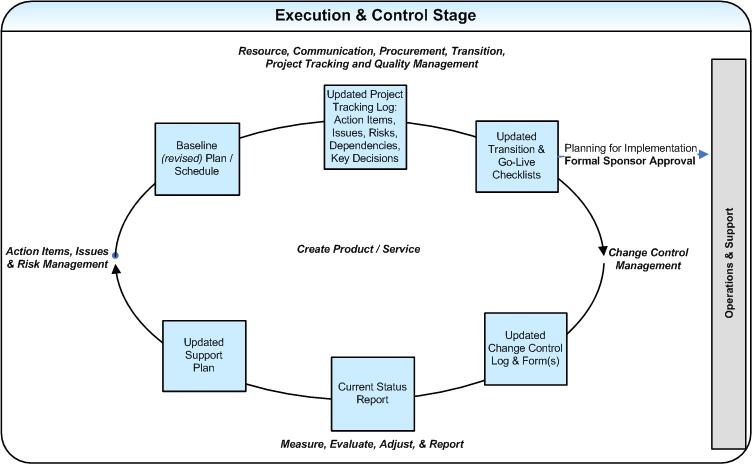
4.2 Outputs
- Recommended Corrective & Preventive Actions
- Recommended Preventative Actions
- Performance, Dashboards and Status Reporting
- Change Control Forms & Change Control Log
- Current Budget vs. Actual Tracking
- Current Project Plan & Schedule Tracking
- Current Communication Register
- Current Project Tracking Log (Action Items, Issues, Risks, Dependencies and Key Decisions)
- Current Transition Checklist & Go-Live Checklist
- Current Procurement Tracking
- Current Quality Tracking Log
- Executed Contracts
- Execution and Control Stage Exit Checklist
- Final Product/Service
- Formal Product/Service Acceptance by Sponsor
5. Closure:
Purpose
This is the final stage in the project life cycle and is triggered when the sponsor accepts the project. The objectives of this stage are to: transition the product, services and deliverables to operations and support; logically complete administrative and logistical close-out activities; and capture performance information that will help improve future projects.
Due to the broad range of process activities, Closure occurs over a period of time. Acceptances and procurement close-outs occur immediately after the project is delivered; while post implementation review workshop sessions, surveys and lessons learned sessions typically occur approximately 4-6 weeks after the official implementation/transition of the project. The goal is to allow for sufficient time to lapse so that the full extent of benefits and short-comings of the project can be identified and discussed.
5.1 Inputs
- Survey/interview key stakeholders including: team members & support.
- Post implementation review and lessons learned sessions
- Existing contracts

5.2 Outputs
- Project deliverables turned over to operations, support and help desk
- Post Implementation Review Surveys, Report
- Post Implementation Documented/shared Lessons Learned and Project Successes
- Contracts closed out; other procurement processes closed
- Team disbanded; financial accounts closed; equipment & facilities redistributed
- Project documentation collected and updated in repository.
- Closure Stage Exit Checklist
 Working too much is likely to decrease your productivity, leave you creatively drained, and negatively affect relationships with friends and family. Don’t get me wrong, pursuing your passion is a beautiful gift and there is nothing wrong with working hard on projects you love. However, it’s essential to take breaks. Whether you’re working from home or in an office environment it’s essential to nourish your creative spirit.

 Constantly question your goals and life purpose.
 Get enough sleep! Staying up late to work on a project and then getting up at 5 am to go into the office is not a good strategy. Lack of creativity, diminished morale and irritability are a few traits of people who go without sleep. Work smarter, not harder.
 Spend time in nature. Spending time in nature is a great way reduce stress, disconnect from everyday worries and incoming work messages. Set aside time in your daily life to go outside. For instance, take a half hour walk everyday and be mindful of your surroundings. There is no need to rush. Take your time, try to understand your instinctual feelings and observe the natural beauty in your neighborhood.
 Listen to your body. If you are working too much you will start feeling tired, cranky and apathetic. All of these symptoms are a sign that you need to slow down. It’s essential to listen to your body. When you listen to your body, you’ll know when you’re sick or just need some extra rest.
 Unplug from the internet. Getting work done doesn’t require an internet connection. It’s amazing what can happen when you step out from behind the computer screen or your mobile device. Most of my killer ideas come to me when I’m taking a shower, on a walk, cooking a meal, and “not working.”Everyone is creative and ideas can come to you at odd moments. Just because you have an idea doesn’t mean you have to implement it right away. Keep a journal with you at all times so that you can capture your idea and enjoy your down time.
 Make time for friends, family and your partner.If you’re working too much, you’re probably sacrificing time with friends, family and your life partner. Doing work you love is extremely important, but so are the people who love you. Consider how you spend your time and what is truly important in life. When you are with your family, friends and life partner, really be there. Make an effort to be present. For instance, if you’re having a conversation with a friend listens to what they are saying. Be engaged and ask questions.
 Eat real food. A side effect of working too much is eating out more and not eating real food. Real food includes fruits, vegetables and whole grains. Before you head out to the office, take time the night before or early in the morning to prepare a healthy breakfast and lunch.
 Reach out to others with a good work-life balance. If you think you’re a workaholic, reach out to others. Connect with friends, family, and consider therapy as an option. If you think this is negatively impacting your life, do something about the problem. We only get one life. So live it well and take care of yourself.
 Thoughts To Inspire