RSS

Category Archives: #Healthcare

How to Build a One-Person ISO Consulting Business in 2026


Each minute of our life is a lesson but most of us fail to read it. I thought I would just add my daily lessons and the lessons that I learned by seeing the people around here. So it may be useful for you and as memories for me.

Helping Startups Achieve Compliance Without Enterprise Consulting Fees

The consulting landscape is changing rapidly.

Startups need ISO certifications more than ever, but many cannot afford large consulting firms charging tens of thousands for implementation and audit support.

This creates an opportunity for experienced professionals.

If you’ve implemented Quality Management Systems, conducted internal audits, or led compliance initiatives, you already have the expertise. With AI and reusable templates, one consultant can now deliver enterprise-quality services efficiently and at an affordable cost.

The goal isn’t to replace consultants with AI. It’s to use AI to eliminate repetitive work so you can focus on what matters most—helping clients achieve compliance.
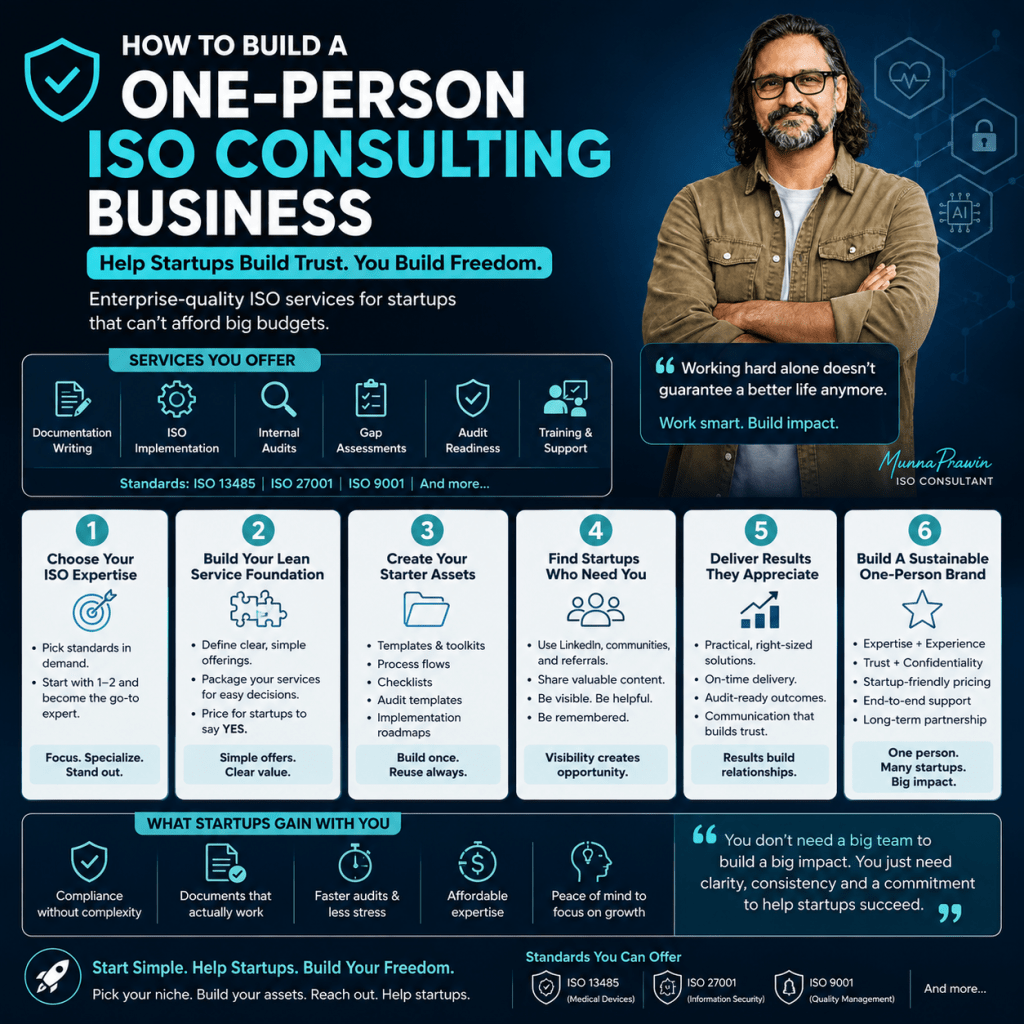
Why This Is a Great Opportunity

Many startups require support with:

  • ISO 13485 – Medical Device Quality Management
  • ISO 27001 – Information Security
  • ISO 9001 – Quality Management
  • ISO 42001 – AI Management Systems
  • FDA & MHRA regulatory readiness
  • Internal audits
  • Supplier audits
  • Risk management
  • CAPA implementation

Most startups don’t need a large consulting firm—they need practical guidance from someone who understands their challenges.

Step 1 – Choose Your Expertise

Avoid trying to become an expert in every ISO standard.

Instead, specialize in one or two areas where you already have practical experience.

Examples include:

Healthcare & Medical Devices

  • ISO 13485
  • IEC 62304
  • ISO 14971

Information Security

  • ISO 27001
  • SOC 2

Quality Management

  • ISO 9001

Specialists are easier to trust and easier to recommend.

Step 2 – Package Your Services

Clients don’t buy consulting hours.

They buy outcomes.

Create clear service packages that solve specific problems.

Documentation Services

Offer complete documentation support, including:

  • Quality Manuals
  • SOPs
  • Work Instructions
  • Policies
  • Templates
  • Forms
  • Process Maps

Implementation Support

Help startups implement their Quality Management System through:

  • Process design
  • QMS implementation
  • Risk Management
  • Document Control
  • Employee training
  • Compliance coaching

Internal Audits

Prepare organizations before certification by providing:

  • Audit Planning
  • Audit Checklists
  • Internal Audits
  • Audit Reports
  • Nonconformities
  • Opportunities for Improvement
  • CAPA recommendations

Certification Readiness

Support companies preparing for Stage 1 and Stage 2 certification audits with:

  • Gap Assessments
  • Mock Audits
  • Evidence Review
  • Management Review preparation
  • Corrective Actions
  • Audit readiness

Step 3 – Build Reusable Assets

One of the biggest advantages of being an independent consultant is creating assets once and using them repeatedly.

Develop your own library of:

  • SOP templates
  • Policies
  • Audit checklists
  • Risk registers
  • CAPA templates
  • Process flow diagrams
  • Training presentations
  • Work instructions
  • Supplier evaluation forms
  • Management Review templates

Each new engagement becomes faster while maintaining consistency and quality.

Step 4 – Use AI to Increase Productivity

AI should support your work—not replace your expertise.

Use AI for:

  • Drafting procedures
  • Formatting documentation
  • Creating templates
  • Generating audit checklists
  • Process flow diagrams
  • Meeting summaries
  • Training material
  • Brainstorming risks

Keep human expertise focused on:

  • Regulatory interpretation
  • Client discussions
  • Audit interviews
  • Compliance decisions
  • Business strategy
  • Leadership

Experience builds trust.

AI improves efficiency.

Step 5 – Build Your Personal Brand

People hire consultants they trust.

One of the best ways to build trust is by consistently sharing useful content.

Write about:

  • ISO implementation tips
  • Audit preparation
  • Common compliance mistakes
  • Risk management
  • CAPA examples
  • Documentation best practices
  • Lessons learned from projects

Consistency creates credibility.

Step 6 – Find Your First Clients

You don’t need a large marketing budget.

Focus on places where founders and startup teams already spend time.

Good channels include:

  • LinkedIn
  • Startup communities
  • Slack groups
  • Founder networks
  • Incubators
  • Technology events
  • Professional referrals

Help first.

Business follows.

Deliver Practical Solutions

Many consultants focus on producing documents.

Successful consultants build systems that organizations actually use.

Your focus should be:

  • Practical documentation
  • Simple implementation
  • Audit-ready processes
  • Clear responsibilities
  • Sustainable Quality Management Systems

Compliance should support business growth—not create unnecessary bureaucracy.

Common Mistakes to Avoid

  • Trying to offer every ISO standard
  • Writing documents that nobody follows
  • Charging only by the hour
  • Reusing generic templates without customization
  • Ignoring personal branding
  • Doing everything manually
  • Waiting for referrals instead of creating visibility

Your Competitive Advantage

As a one-person ISO consultant, you can offer:

  • Direct access to an experienced consultant
  • Faster turnaround times
  • Startup-friendly pricing
  • Flexible engagement models
  • Practical implementation
  • Personalized support
  • Long-term partnership

For many startups, this provides greater value than working with a large consulting firm.

Recommended Service Portfolio

Documentation

  • Quality Manuals
  • SOPs
  • Policies
  • Work Instructions
  • Templates

Implementation

  • QMS Setup
  • Risk Management
  • Process Mapping
  • Employee Training
  • Supplier Management

Audits

  • Internal Audits
  • Gap Assessments
  • Supplier Audits
  • Mock Certification Audits

Certification Support

  • ISO 13485
  • ISO 27001
  • ISO 9001
  • ISO 42001
  • Stage 1 & Stage 2 Audit Preparation

Ongoing Support

  • CAPA
  • Change Management
  • Management Reviews
  • Continuous Improvement
  • Annual Audit Support

Final Thoughts

A successful one-person ISO consulting business isn’t built by working longer hours.

It’s built by combining:

  • Deep industry expertise
  • AI-assisted productivity
  • Reusable templates and systems
  • Consistent personal branding
  • Practical, client-focused consulting

Start with one niche.

Build reusable assets.

Share your knowledge consistently.

Focus on delivering real business value—not just documentation.

One experienced consultant can help dozens of startups achieve certification while building a sustainable, rewarding consulting business.

If you wanna share your experiences, you can find me online in all your favorite places  LinkedIn and Facebook. Shoot me a DM, a tweet, a comment, or whatever works best for you. I’ll be the one trying to figure out how to read books and get better at playing ping pong at the same time.

 
Leave a comment

Posted by on July 26, 2026 in #Healthcare, Work Place


Tags: , , , , , , , , , , , , , , , ,

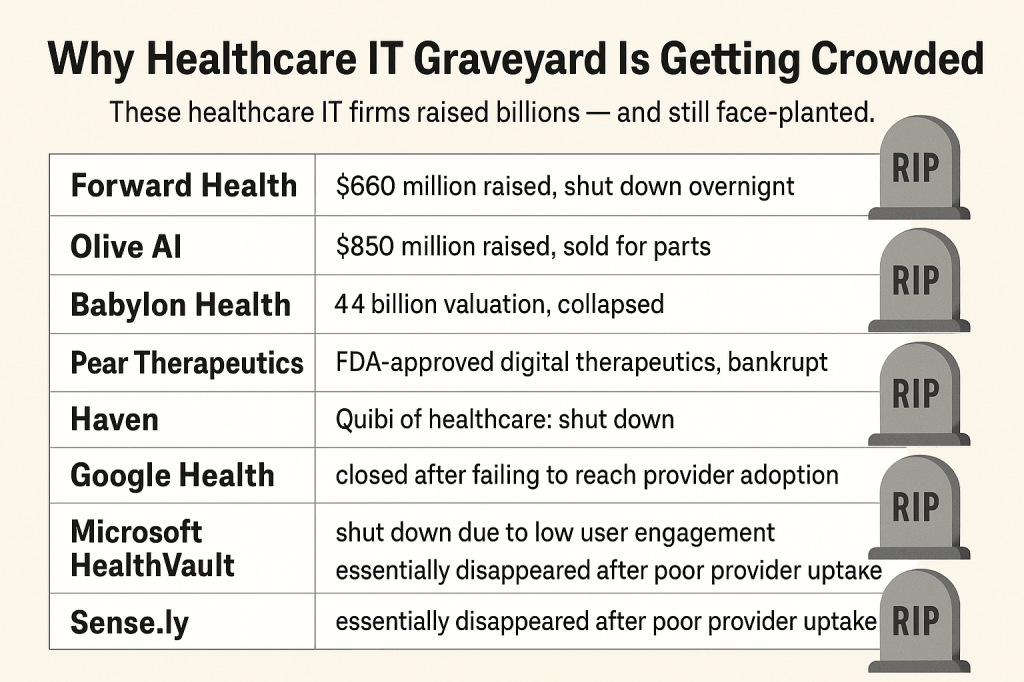
Why Healthcare IT Graveyard Is Getting Crowded


Each minute of our life is a lesson but most of us fail to read it. I thought I would just add my daily lessons and the lessons that I learned by seeing the people around here. So it may be useful for you and as memories for me.

I’ve spent more than a decade building healthcare products across Europe, Asia, and the U.S. I’ve led Quality, Product, and Delivery at scale. I’ve watched companies grow explosively, and I’ve watched companies vanish overnight literally.

And after 15 years working in healthcare, the pattern is painfully clear:

Healthcare tech doesn’t fail because of weak engineering. It fails because founders fundamentally misunderstand healthcare.

Here’s the uncomfortable truth — backed by recent, spectacular collapses.

The Graveyard Is Getting Crowded

These aren’t small startups. These were the darlings of global healthcare tech:

  • Forward Health – $660M raised, shut down with zero patient transition
  • Olive AI – $850M raised, sold for parts after failing to justify ROI
  • Babylon Health – $4B valuation, blew up across multiple continents
  • Pear Therapeutics – FDA-cleared digital therapeutics, bankrupt
  • Quibi of Healthcare: Haven (Amazon–JPM–Berkshire) – shut down despite unlimited resources
  • Google Health (v1) – closed after failing to reach provider adoption
  • Microsoft HealthVault – shut down due to low user engagement and system complexity
  • Sense.ly (AI nurse avatar) – essentially disappeared after poor provider uptake
  • 23andMe Therapeutics spinout – quietly scaled back after no viable clinical revenue stream
  • Walgreens / Theranos fallout – major proof that hype beats due diligence in this sector
  • Proteus Digital Health (smart pill) – raised $500M, then bankrupt
  • Practice Fusion – sold for pennies after criminal investigations and failed EHR monetization
  • ZocDoc expansion failure – pivoted multiple times after failing to win provider-side economics
  • Oscar Health (several failed geographic launches) – struggled due to regulatory economics
  • IBM Watson Health – $3B+ investment, divested for $1B after clinical failures

This list is long. And growing.

The Core Misunderstanding: Healthcare Is Not a Tech Problem

Engineering-driven founders consistently misdiagnose the domain.

They believe healthcare = complex workflows + messy data + outdated UI.

Solve that and… success.

But healthcare is not a systems problem.

It is a trust problem wrapped in regulation, economics, and risk.

  • Lives are at stake — not convenience.
  • Medical decisions require validated evidence — not beta features.
  • Clinicians rely on reliability and accountability — not iteration velocity.
  • Patients don’t adopt new care models without months or years of trust-building.

Every failed company ignored these constraints.

The Integration Trap: The Silent Killer

This is where most companies die.

Healthcare runs on a brittle spine of EMRs, APIs, and legacy systems.

If you don’t integrate, you don’t exist.

  • Forward’s CarePods were genuinely innovative. But without seamless EMR connections, they became operationally useless.
  • Olive AI automated tasks internally… but could not standardize ROI across EMRs.
  • IBM Watson Health promised AI-driven oncology decisions. But the recommendations were inconsistent with evidence-based guidelines.

The rule:

If you don’t reduce workload inside the existing workflow, clinicians will ignore you.

No integration = no adoption.

No adoption = no revenue.

No revenue = shutdown.

Why Consumer Tech Logic Fails in Healthcare

Tech founders try to import playbooks from SaaS, marketplaces, and fintech:

  • “Move fast and break things”
  • “Launch MVP, iterate later”
  • “Acquire users, figure out monetization later”
  • “Data is the new oil”
  • “AI will replace inefficiencies”

These logics collapse immediately in healthcare:

  1. Healthcare data is not clean; 80% is unstructured.
  2. Interoperability is not an optional feature — it is the foundation.
  3. Clinicians require evidence, not velocity.
  4. Patients are not early adopters; they are risk-averse by necessity.

The market punishes anyone who treats healthcare like another consumer vertical.

The Reimbursement Illusion: Where Startups Bleed Out

This is the part Silicon Valley consistently ignores.

In healthcare, value is NOT determined by the end user.

Value is determined by:

  • payors
  • reimbursement codes
  • medical necessity rules
  • regulatory status
  • clinical outcomes data

A product can delight users and still die if:

  • there’s no CPT code
  • insurers won’t reimburse
  • the product doesn’t reduce provider workload
  • there’s no proven cost savings

Olive AI is the textbook example.

Automation sounded brilliant — but if hospitals can’t bill for it, the business collapses.

Pear Therapeutics had FDA clearance, efficacy data, and clinical logic.

Still died because payors refused to reimburse at scale.

Healthcare economics — not innovation — determine survival.

What Actually Works (and Why It Looks “Unsexy”)

The successful products in healthcare are almost never glamorous:

  • Automated population stratification
  • Scheduling optimization
  • Revenue cycle improvements
  • Medication adherence
  • Secure messaging
  • Chronic disease workflows
  • Interoperability middleware
  • Claims cleaning and fraud detection

Unsexy wins because it integrates, it reduces workload, it fits reimbursement, it avoids clinical risk, and it solves one painful problem extremely well.

The companies that succeed do the following:

  • Integrate seamlessly with EMRs
  • Prove ROI early
  • Reduce clicks, not add them
  • Earn clinical champions, not marketing awards
  • Build for the system as it is, not the system they wish existed
  • Grow slowly but sustainably — not explosively and unsafely

Healthcare rewards evolution, not revolution.

Forward Health’s Shutdown Is the Perfect Case Study

Forward turned off the lights overnight:

  • No transition pathway
  • Canceled appointments
  • Patients left stranded
  • Systems turned off immediately

This is what happens when a company:

  • optimizes for investor excitement instead of clinical safety
  • designs for TechCrunch instead of clinicians
  • prioritizes disruption over integration
  • treats healthcare as a retail subscription business instead of a regulated service

Patients pay the real cost of these failures.

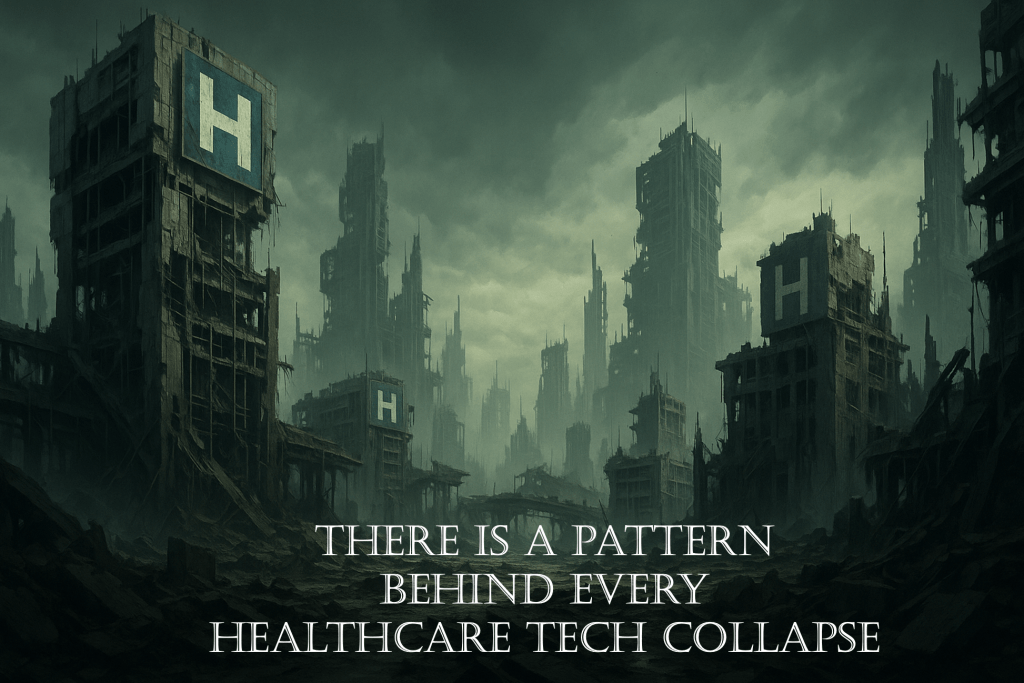
The Real Pattern Behind Every Healthcare Tech Collapse

Let’s stop pretending these are isolated incidents.

The failures follow the same template:

  1. Overpromise with polished demos
  2. Underestimate the complexity of clinical workflows
  3. Blow capital on growth before solving integration
  4. Fail to secure reimbursement pathways
  5. Struggle to prove clinical and financial ROI
  6. Lose trust from clinicians
  7. Run out of money
  8. Collapse suddenly
  9. Patients and providers are left scrambling

Money and engineering talent are not substitutes for:

  • clinical insight
  • regulatory design
  • healthcare economics
  • trust-building
  • real-world workflow alignment

The Hard Truth

Healthcare rewards reliability over innovation.

Simple solutions outperform brilliant ones.

Integration beats disruption every time.

I’ve watched billion-dollar firms fail and small scrappy teams succeed.

The winners understood healthcare is a trust-based, evidence-driven system.

The losers thought they could brute force the market with capital and code.

They were wrong.

Your Turn

What healthcare product promised everything and delivered nothing?

If you wanna share your experiences, you can find me online in all your favorite places  LinkedIn and Facebook. Shoot me a DM, a tweet, a comment, or whatever works best for you. I’ll be the one trying to figure out how to read books and get better at playing ping pong at the same time.


Tags: , , , , , , , , ,

 
Design a site like this with WordPress.com
Get started