RSS

Monthly Archives: March 2019

Scrum Vs Kanban


Each minute of our life is a lesson but most of us fail to read it. I thought I would just add my daily lessons & the lessons that I learned by seeing the people around here. So it may be useful for you and as memories for me.

Article by AXA XL Team…

Which framework works best: Kanban or Scrum? If you are on the verge of a brand new project, I bet this question has posed quite the challenge to your mind. Today Kanban and Scrum have grown in popularity and have taken the place of the previously popular waterfall method.

Agile –  Agile software development is based on an incremental, iterative approach. Instead of in-depth planning at the beginning of the project, Agile methodologies are open to changing requirements over time and encourages constant feedback from the end users. Cross-functional teams work on iterations of a product over a period of time, and this work is organized into a backlog that is prioritized based on business or customer value. The goal of each iteration is to produce a working product.

Scrum – The approach followed here is breaking down a complex task into simpler smaller manageable pieces which are easy to collaborate upon by the respective owners of the scrum.

Kanban – It is a Continuous improvement, flexible process. Kanban helps visualize your work, limit work-in-progress(WIP) and quickly move work from “Doing” to “Done.” It is a framework which utilizes visualization technique, limiting the number of tasks to be taken in “Work in Progress” column.

Scrum Vs Kanban

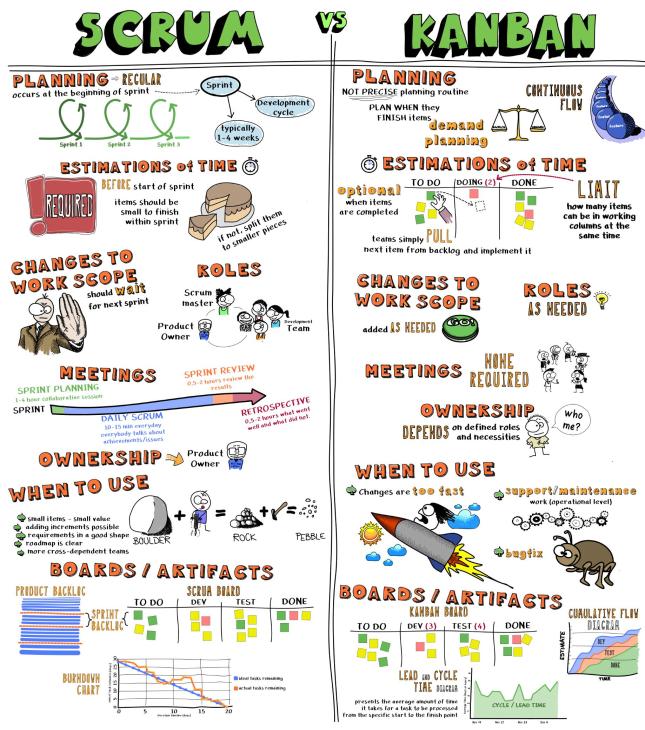
Kanban and Scrum are both iterative Agile development models, the goal is to get the most important tasks fully done (including testing) as soon as possible. The product should be potentially shippable at the end of the iteration. The difference is with Scrum the end is a set date, with Kanban it could be anytime the features that need releasing are done. In Scrum you plan a fixed period of time and with Kanban you plan just in time.
ks1.jpg

Roles –

  • Scrum is dependent on the scrum owners and is worked upon by them respectively. Scrum has three clearly defined roles.
    1. The product owner advocates for the customer, manages the product backlog, and helps prioritize the work done by the development team.
    2. The scrum master helps the team stay grounded in the scrum principles.
    3. The scrum team chooses the work to be done, delivers increments, and demonstrates collective accountability
  • Kanban is independent of cross-functional team members and parallel roles. The whole team owns the kanban board. Some teams enlist an agile coach but, unlike scrum, there is no single “kanban master” who keeps everything running smoothly. It’s the collective responsibility of the entire team to collaborate on and deliver the tasks on the board.

Release cycle –

  • Scrum makes use of sprints whose duration varies from one week to two weeks. The user stories are then taken up for development, testing and bug fixes. Nowadays, it’s common to have ad-hoc releases in scrum, but it’s long been a best practice to release at the end of each sprint. Teams set an objective for each sprint, the sprint goal, and either approves it for release in the sprint review meeting, or don’t
  • Kanban does not follow any cycle and the process is continuous in nature. In kanban, updates are released whenever they are ready, without a regular schedule or predetermined due dates. In theory, kanban does not prescribe a fixed time to deliver a task. If the task gets completed earlier (or later), it can be released as needed without having to wait for a release milestone like sprint review.

Tracking parameters –

  • Scrum makes use of velocity in planning upcoming sprints taking into account the complexity and number of user stories completed in the previous sprint.
  • Kanban ensures limiting of user stories in “Work in Progress” column to avoid bottlenecks. It tracks the time taken to finish a task from the starting to the end.

The scope of improvement –

  • Scrum does not encourage changes in ongoing sprints.
  • Kanban is open to any changes before the completion of the project. It is flexible in nature.

Fit factor –

  • Scrum is suitable for projects with clearly defined user stories. Acknowledgement on the same by the client for timely completion of the project makes it a fit.
  • Kanban being flexible in nature allows variations in priorities on the basis of the current scenario.

Pick process –

  • Scrum picks the entire batch of user stories from the product backlog for development.
  • Kanban follows the maximum number of tasks allowed in the columns to maintain the sanity of the framework and to avoid bottlenecks.

Delivery –

  • Scrum follows delivery based on sprint planning and prioritize based on the specifications given by the client.
  • Kanban follows the continuous delivery model based on business needs.

Key metrics

  • Scrum – Velocity i.e. the number of story points completed in a sprint—is the central metric for scrum teams. It guides future sprint commitments, or how much work the scrum team takes on in future sprints. If the team completes an average of 35 story points per sprint (Velocity = 35), it won’t agree to a sprint backlog that contains 45 points.
  • Kanban – Lead time and cycle time are important metrics for kanban teams. The deal with the average amount of time that it takes for a task to move from start to finish. Improving cycle times indicates the success of kanban teams.

The above points are easy to remember if you are able to visualize working on them. Ideally where the scrum follows a rather predefined set of principles. Kanban is backed up by the principle of flexibility. It allows you to track tasks that are of utmost importance for delivery.

What Is Kanban? ks3

In order to simplify the manufacturing process and increase efficiency, in the 1940s Toyota implemented just-in-time manufacturing—effectively, making only what is needed, only when it is needed, and only in the amount that is needed.

Kanban is great for teams that have lots of incoming requests that vary in priority and size. Whereas scrum processes require high control over what is in scope, kanban let’s you go with the flow. Let’s take a look at the same five considerations to help you decide. What makes Kanban interesting is this aspect of it – that you could be continuously developing, integrating, testing and releasing at a cadence that you feel comfortable with – and so the whole concept of Continuous Delivery becomes much more ‘natural’ with Kanban.

How Does Kanban Work?

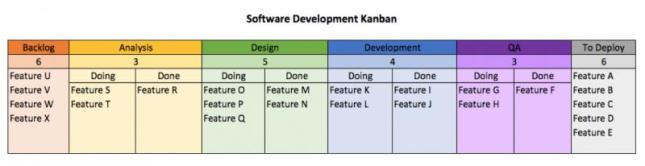
The only essential materials for kanban are a marker, sticky notes, and a board. Create “cards” from the sticky notes representing work items that have to go through several phases, from start to finish. Then draw columns on the board for each phase the cards need to go through, with a number at the top of each column that indicates the maximum number of cards (i.e., work in progress) that can be in that phase at a time. This number probably will and should change as your team improves its ability to gauge and reduce bottlenecks. The columns could simply be labeled “to do,” “doing,” “waiting,” and “done,” or they can be more process-specific, such as in the examples below.

Another helpful thing many teams do is dividing the columns in two, with one lane for “doing” and one for “done,” as you can see in the software development kanban example above. This way, it is clear to whoever is in charge of the following column to know when they can pull another card and begin working on it.
ks 2

The beauty of this system is that it helps you detect where bottlenecks are. The work-in-progress limit stimulates conversations about process problems. In the examples above, you can see some columns are at capacity and some are not, but none has more cards than prescribed.


Please feel free to share your story and any lessons you learned, you experienced, you came across in your life in the comments below.



1 Comment

Posted by on March 22, 2019 in Technical


Tags: , , ,

Request to Parents & Parents-to-be


Each minute of our life is a lesson but most of us fail to read it. I thought I would just add my daily lessons & the lessons that I learned by seeing the people around here. So it may be useful for you and as memories for me.

Every Child’s Childhood should be carefree, playing in the sun; not living a nightmare in the darkness of the soul. Child abuse casts a shadow the length of a lifetime. The only reason why child abuse is alive today, is because we as adults fail our children when we fail to listen to them. Listen to a child today! Child Abuse Main Image

Any for of Abuse manipulates and twists a child’s natural sense of trust and love. Her innocent feelings are belittled or mocked and she learns to ignore her feelings. She can’t afford to feel the full range of feelings in her body while she’s being abused—pain, outrage, hate, vengeance, confusion, arousal. So she short-circuits them and goes numb. For many children, any expression of feelings, even a single tear, is cause for more severe abuse. Again, the only recourse is to shut down. Feelings go underground.

As parents you would always want your kids to grow up as loving, kind, happy and successful individuals. You want them to love and to be loved by all. In the process you teach them many things which are good for their life and future.

In the similar way, make sure to consider below points and teach you Children at early age. You must remind your kids from time and again that you would always be by their side when required and help them when required. Ask your kid to maintain a positive frame of mind, so that she can easily overcome hurdles that she comes across in her life.

1: Warn your Girl Child Never to sit on anyone’s laps no matter the situation including uncles.

2: Avoid Getting Dressed in front of your child once he/she is 2 years old. Learn to excuse them or yourself.

3. Never allow any adult refer to your child as ‘my wife’ or ‘my husband’

4. Whenever your child goes out to play with friends make sure you look for a way to find out what kind of play they do, because young people now sexually abuse themselves.

child-abuse-750x5385. Never force your child to visit any adult he or she is not comfortable with and also be observant if your child becomes too fond of a particular adult.
6. Once a very lively child suddenly becomes withdrawn you may need to patiently ask lots of questions from your child..

7. Carefully educate your grown ups about the right values of sex . If you don’t, the society will teach them the wrong values.

8: It is always advisable you go through any new Material like cartoons you just bought for them before they start seeing it themselves.

9. Ensure you activate parental controls on your cable networks and advice your friends especially those your child(ren) visit(s) often.

10. Teach your 3 year olds how to wash their private parts properly and warn them never to allow anyone touch those areas and that
includes you (remember, charity begins from home and with you).

11: Blacklist some materials/associates you think could threaten the sanity of your child (this includes music, movies and even friends and families).

12. Let your child(ren) understand the value of standing out of the crowd.

13: Once your child complains about a particular person, don’t keep quiet about it. Take up the case and show them you can defend them.

Child(ren) abuse changes your life…Fight Back and change the life of your abusers by Breaking Your Silence on Abuse!

These are just few, but important life lessons that you should teach your kid. You have some more to add on this? Share with us if u have some more life lessons to teach kids by mentioning them in the comment section below.

Remember, we are either parents or parents-to-be. and remember “THE PAIN LASTS A LIFETIME”. And if possible forward to all friends who have children’s


Please feel free to share your story and any lessons you learned, you experienced, you came across in your life in the comments below.


Tags: , , , ,

Potluck Lunch helps in Team Building


Each minute of our life is a lesson but most of us fail to read it. I thought I would just add my daily lessons & the lessons that I learned by seeing the people around here. So it may be useful for you and as memories for me.

In any organisation, team work can make all the difference between success and failure. That’s because collaborative teams excel at dividing responsibilities and working towards the same goal. Realising this, most teams are focusing on team building exercises that can bring teams closer.

Maintaining a healthy work culture, one that keeps the entire team motivated and enthused, can be a tough task. You see your employees going through their everyday tasks in a routine, and on the surface, everything might look happy and gay, but you never know when monotony can kick in and leave the entire system uninspired.

Just a small activity is enough to see the change in the overall enthusiasm and energy of the office. It can also be a great way for newbies to feel comfortable and at ease with the rest of the team.

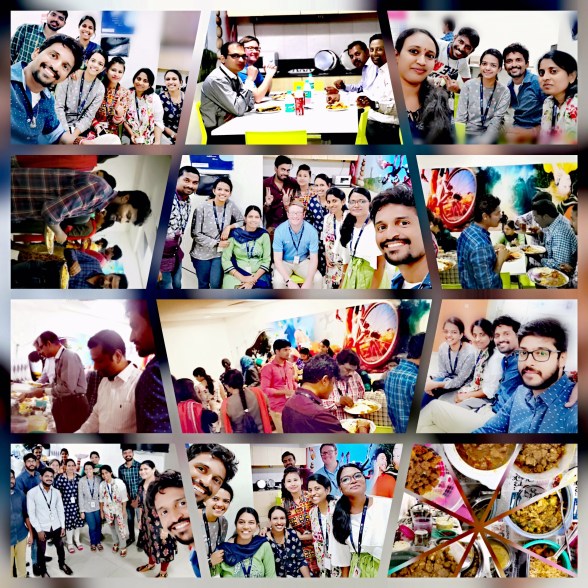
Recently we had a team Potluck lunch organised by my lovely team ladies. Special thanks to my loving Vijaya Ragi & Team for handling everything in a smooth way. It is well planned and organised.

IMG_20190306_215519

If you want your team to feel energised at all times, to enjoy what they’re doing and love working for you – and for this, you cannot lay enough emphasis on the need for recreational activities. While some offices go for activity outings, we actually have a simpler and cheaper alternative that can be just as rewarding. The other simple yet effective team building activity is a potluck. It can be organised  by anyone without costing a penny to the company.

But what exactly is it and how does it help in building teams?

What Is an Office Potluck?

In simple terms, a potluck is an occasion when attendees bring food to be shared with everyone. Whether it has a theme or not, is completely up to the team members.

The main idea is to add some fun to the workplace and encourage employees to connect with one another over food.

How to Organise  an Office Potluck

The best thing about a potluck is that you don’t need a big reason to organise  it. It could be an occasion to celebrate a holiday or just the first day at work after a long holiday.

You simply need an organiser  to send out the emails and coordinate with everyone involved.

Sometimes the organiser  may allocate responsibilities to the team members. For example, you may ask two employees to take care of the dessert and two others to bring some appetisers . Or you may choose to let the employees decide among themselves.

Office Potluck for Team Building

Do you sense a growing lack of communication between two team members? A potluck lunch can be of great help.

Get those two employees to plan the potluck. Ask them to coordinate the menu and come up with two dishes that everyone can enjoy.

The objective here is to get them to communicate with each other and find a simple solution. You may or may not oversee how they do this, but the end result can help them connect with each other.

At a later point, you may even speak to the two employees separately to get an idea how they felt about the whole exercise.

A potluck is also a great occasion to bring a close-knit team closer. As many small businesses have fewer employees working for them, a potluck lunch can give them a reason to discuss things beyond work. Often such discussions may reveal hidden talents and opportunities for business growth.

Whatever you do, remember to have fun and enjoy some good food.

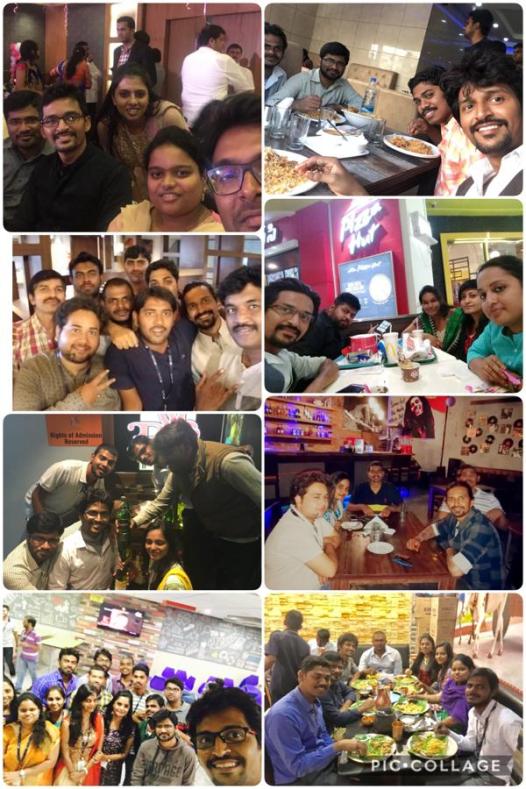
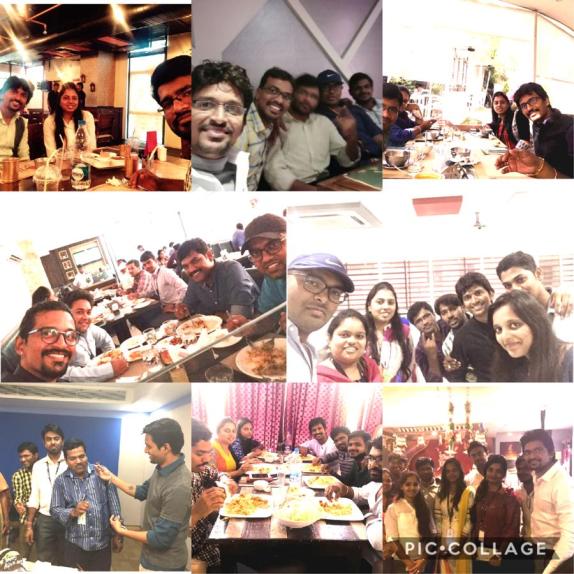
Below are some glimpses of my teams Potluck events.

IMG-20190221-WA0008

WhatsApp Image 2020-05-03 at 7.25.51 AM

IMG_20180428_075142

WhatsApp Image 2020-05-03 at 7.21.36 AM

In conclusion, I would like to point out one very important fact. This is the deciding force. More convincing than any research paper or analysis. This is the real, ultimate deal-breaker: Your office is going to be flooded with yummy home-made FOOD for one whole day! Do you still need another reason?

Please feel free to share your story and any lessons you learned, you experienced, you came across in your life in the comments below. If you enjoyed this, or any other other posts, I’d be honoured  if you’d share it with your family, friends and followers!

If you wish to follow my journey outside of my writing, you can find me on Facebook (https://www.facebook.com/MunnaPrawin) Instagram(MunnaPrawin) and Twitter(@munnaprawin).


Tags: , , , , , ,

 
Design a site like this with WordPress.com
Get started