RSS

Tag Archives: MHRA

Your Software Doesn’t Get Approved. Your Evidence Does.


Each minute of our life is a lesson but most of us fail to read it. I thought I would just add my daily lessons and the lessons that I learned by seeing the people around here. So it may be useful for you and as memories for me.

Why the Most Successful MedTech Startups Build Trust Before They Build Features

Software has transformed healthcare.

Today, a single application can help clinicians detect diseases earlier, monitor patients remotely, support treatment decisions, and even leverage Artificial Intelligence to improve outcomes.

Artificial Intelligence, cloud computing, remote patient monitoring, and digital therapeutics are transforming healthcare faster than ever before. Every day, startups launch innovative solutions designed to improve clinical workflows, reduce costs, and deliver better patient outcomes.

Yet many of these companies face an unexpected challenge when preparing for regulatory approval.

The obstacle isn’t the technology.

It’s the evidence behind the technology.
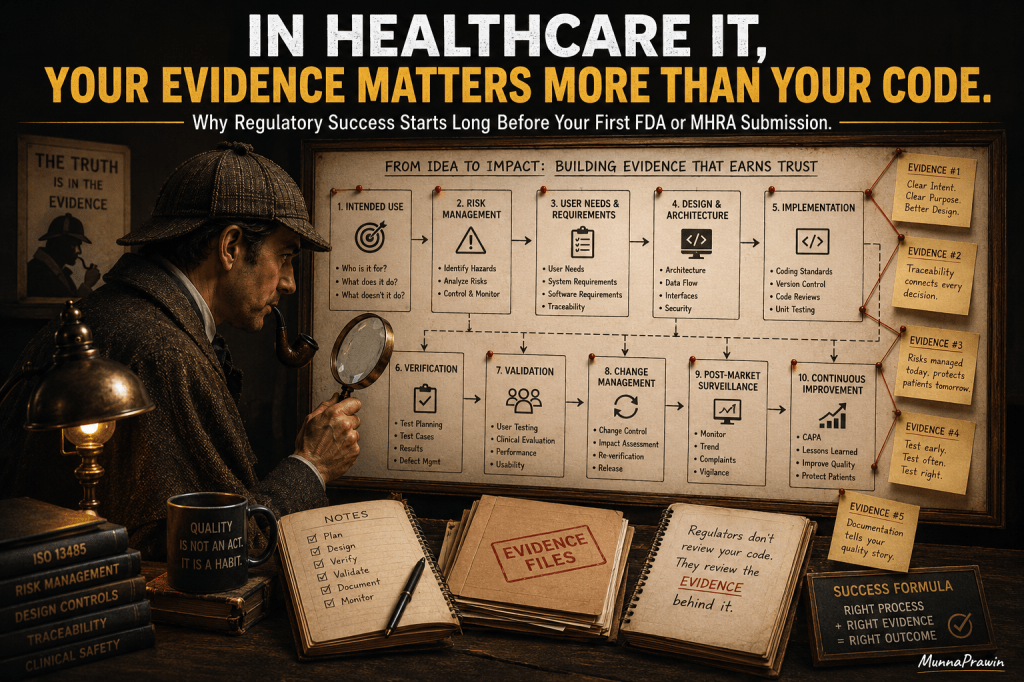
Having worked with leading Electronic Health Record (EHR) platforms including EMIS, TPP SystmOne, and Epic, and more recently leading an ISO 13485 implementation for a Software as a Medical Device (SaMD) organization, I’ve learned that regulators don’t simply evaluate software—they evaluate the process used to build it.

That’s a mindset every healthcare startup needs to embrace.

Innovation Gets Attention. Evidence Earns Approval.

Many startups believe success is measured by:

  • Faster releases
  • Better user experience
  • AI-powered capabilities
  • Modern cloud architecture
  • Rapid customer growth

These are all important.

But healthcare is different.

Whether you’re preparing for FDA, MHRA, ISO 13485, or IEC 62304 compliance, regulators are asking a different question:

“Can you objectively demonstrate that your software is safe, effective, and consistently performs as intended?”

That’s a much higher standard than simply delivering working software.

Healthcare Software Is More Than Code

One of the biggest lessons I’ve learned throughout my career is this:

Medical software is not just an application.

It is a collection of evidence.

Every requirement.

Every design decision.

Every risk assessment.

Every verification activity.

Every release.

Together they create a complete story demonstrating that your product deserves to be trusted.

The software may save lives.

But the evidence proves why it should.

The Five Questions Every Regulator Wants Answered

Regardless of which regulatory framework you’re following, most reviews ultimately focus on five fundamental questions.

1. Is the Intended Use Clearly Defined?

Everything begins here.

If your intended use is vague, your regulatory pathway becomes equally unclear.

A strong intended use explains:

  • Who the users are
  • What clinical problem the software addresses
  • What decisions it supports
  • What it explicitly does not do

Clear intended use drives better design, testing, and risk management.

2. Have You Identified and Controlled Risks?

No medical device is risk-free.

The expectation isn’t zero risk.

The expectation is that risks have been systematically identified, evaluated, mitigated, and monitored throughout the product lifecycle.

Risk management isn’t just another document.

It’s a design activity.

3. Can Every Requirement Be Traced?

One feature.

One requirement.

One verification.

One result.

That traceability should exist throughout the entire development lifecycle.

Without traceability, demonstrating compliance becomes significantly harder.

4. Have You Proven the Software Works?

Testing is far more than checking whether the application runs.

Verification demonstrates that requirements have been implemented correctly.

Validation demonstrates that the software actually meets user needs within its intended clinical environment.

Both are equally important.

5. Can You Explain Every Change?

Healthcare software continuously evolves.

New features.

Security updates.

Bug fixes.

AI improvements.

Every significant change should be assessed for potential impact on patient safety before release.

Good change control protects both patients and your organization.

What Working Across Different Healthcare Platforms Has Taught Me

Over the years I’ve had opportunities to work with healthcare platforms supporting different healthcare systems and clinical workflows.

Whether it’s EMIS, TPP SystmOne, Epic, or other regulated healthcare environments, one thing consistently stands out.

The organizations that succeed don’t view compliance as the responsibility of the Quality team alone.

Quality becomes part of engineering.

Developers understand risk.

Architects understand traceability.

Product owners understand intended use.

Leadership understands governance.

When everyone shares responsibility, audits become confirmation—not crisis management.

Practical Advice for Healthcare Startups

If you’re building your first regulated healthcare product, don’t wait until six weeks before an audit to think about compliance.

Instead, build it naturally into your development process.

Here are six practices that consistently make a difference.

✅ Define Your Intended Use Before Writing Code

A well-written intended use statement becomes the foundation for every regulatory activity that follows.

✅ Integrate Risk Management into Product Design

Risk management shouldn’t begin after development.

It should influence architecture, workflows, and technical decisions from day one.

✅ Build Traceability Early

Don’t leave traceability until release.

Connecting requirements, risks, development, verification, and validation throughout the project saves enormous effort later.

✅ Keep Documentation Alive

Documentation should evolve alongside the software—not become a last-minute exercise before certification.

Current documentation reflects current quality.

✅ Review Designs Frequently

Short, structured design reviews help identify issues long before they become audit findings or production defects.

✅ Make Compliance Part of Engineering Culture

The best quality systems aren’t maintained by Quality Managers.

They’re supported by the entire organization.

Compliance Doesn’t Slow Innovation

This is one of the biggest misconceptions in healthcare technology.

In my experience, organizations with disciplined development processes often move faster over the long term.

Why?

Because they spend less time fixing avoidable problems.

They build:

  • Better architecture
  • More reliable software
  • Stronger cybersecurity
  • Higher-quality testing
  • Cleaner documentation
  • More predictable releases

Quality isn’t bureaucracy.

Quality is engineering done well.

Final Thoughts

As AI becomes more deeply integrated into healthcare, regulatory expectations will continue to evolve.

But one principle will remain unchanged.

Trust must be earned.

Not through marketing.

Not through impressive demonstrations.

Not through ambitious roadmaps.

Through disciplined engineering.

Through effective quality management.

Through objective evidence.

The healthcare startups that thrive over the next decade won’t simply be those building the smartest software.

They’ll be the ones capable of proving—every step of the way—that their software is safe, effective, and built under control.

And in healthcare, that’s what ultimately matters.

“In Healthcare IT, innovation may open the door—but evidence is what gets you through it.”

If you wanna share your experiences, you can find me online in all your favorite places  LinkedIn and Facebook. Shoot me a DM, a tweet, a comment, or whatever works best for you. I’ll be the one trying to figure out how to read books and get better at playing ping pong at the same time.

 
Leave a comment

Posted by on March 5, 2026 in Experiences of Life.


Tags: , , , , , , , , , , , , , , , , , , , , , ,

MHRA Class I for AVT (AI Scribe) Tools


Each minute of our life is a lesson but most of us fail to read it. I thought I would just add my daily lessons and the lessons that I learned by seeing the people around here. So it may be useful for you and as memories for me.

Over the last several years working in healthcare technology, I have had a front-row seat to the industry’s accelerating relationship with artificial intelligence.

From primary care analytics and NHS interoperability programmes to leading AI-driven product development, I have watched organisations move from curiosity to urgency. Today, commissioners, clinicians, digital leaders, and software vendors are all trying to answer the same question:

How do we use AI to improve care without creating new risk?

The reality is more complex than most roadmaps admit.

Healthcare is adopting AI faster in ambition than in operational capability.

I have seen teams demand “an AI solution” before the problem is defined. I have watched pilots stall because workflows were not ready, governance was misaligned, and data quality could not support the promised outcomes. I have also seen the opposite — where structured safety frameworks, disciplined operations, and clinical ownership produced measurable improvements in care quality, safety, and efficiency.

Nowhere is this contrast more visible than in Ambient Voice Technology (AVT) — AI scribes that listen to consultations and draft clinical notes.

Why AVT Forces the MHRA Class I Conversation

NHS England guidance and multiple NHS-adjacent safety and assurance discussions increasingly position summarisation-capable AVT tools within MHRA Class I medical device scope at minimum.

This is because AVT systems do not merely store information — they influence the clinical record itself. And the clinical record is care.

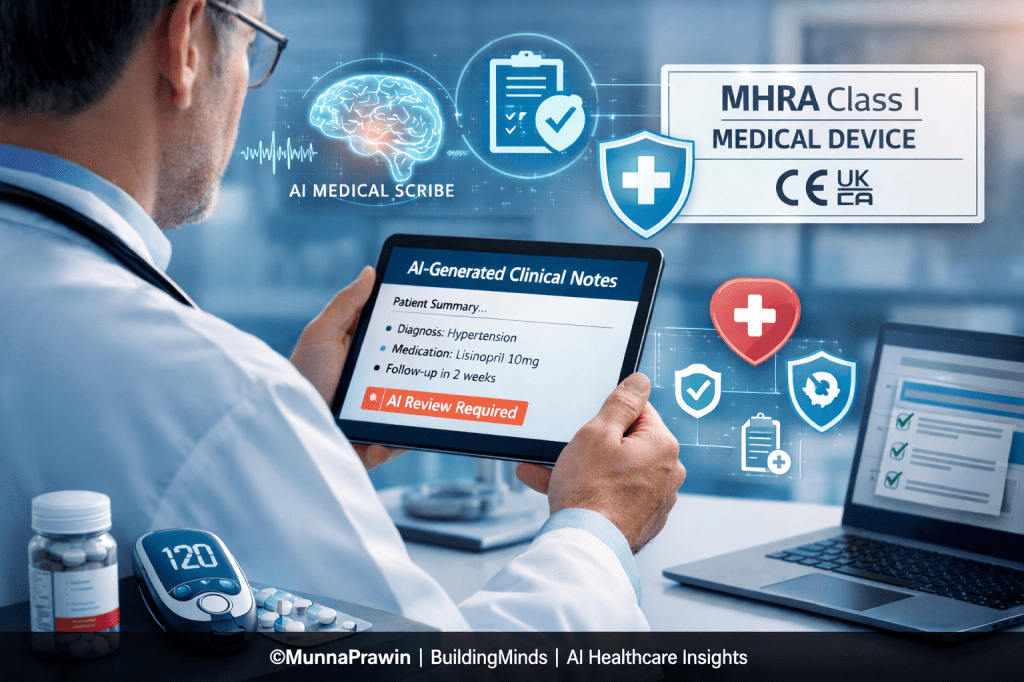
The NHS has said that any AI scribe that provides summaries for physicians must at a MINIMUM be a MHRA Class I medical device.

Previously, many AI scribes in the UK and EU could be used in hospitals without a medical device designation.

There is still a ton of uncertainty around what qualifies software as a medical device in the UK and EU as well as what features change a software’s risk class from a low risk Class I device into the higher risk territory of Class IIA+.

This NHS notice sets a regulatory floor in the UK for AI scribes, making most, if not all, medical devices.

While I’m sure this is alarming for many AI scribe companies, having this level of clarity on regulatory classifications is refreshing.

I might be a lone in that sentiment but it is a benefit in knowing exactly what your regulatory requirements are.

To dive into the details a bit more, the NHS has declared the following:
– Scribes that generate summarization must have at least MHRA Class 1 medical device status.
– Solutions aiming to produce generative diagnoses or management plans require at least MHRA Class IIa approval.
– Suppliers must provide evidence of real-world clinical validation within a care setting, demonstrating benefits such as enhanced efficiency, reduced administrative burden, and improved patient care and data quality.
– Patient data from clinical sessions should be automatically deleted unless legally or operationally required

Class I is not a registration hurdle.

It is the threshold at which regulators, commissioners, and NHS assurance bodies effectively ask:

Can we trust this company to behave like a medical device manufacturer — particularly when something goes wrong?

Anyone who has handled real incidents — logging safety concerns, coordinating root cause investigations, running calls with frontline clinicians, and closing corrective actions — understands that compliance is not theoretical.

It is operational muscle.

What Class I Readiness Actually Requires (Across the Organisation)

1. Product: Turning Features into Medical Claims

AVT companies must explicitly define:

  • Intended purpose and non-purpose
  • Outputs (transcripts, summaries, structured notes, coding suggestions, letters, write-back boundaries)
  • Users and workflows
  • Medical vs administrative positioning
  • Traceability: feature → hazard → mitigation → test → release

Reality:

If your product generates “clinical summaries,” you must show how you prevent omissions, hallucinations, misattribution, and medication/allergy errors.

2. Development: Building Evidence, Not Just Code

Class I requires:

  • Documented SDLC
  • Risk-based testing
  • Controlled release management
  • Audit trails
  • Enforced human-in-the-loop review

Reality:

Edge cases such as accents, interruptions, and noisy environments must have test evidence — these are not theoretical risks.

3. Clinical Safety: Designing for Real Workflow

Deliverables include:

  • Formal hazard logs
  • Clinical safety cases and sign-off governance
  • Human factors analysis
  • Clear “not for” boundaries

Reality:

A confident-sounding summary can be more dangerous than an obviously incomplete one.

4. Operations: Running a Regulated Service

This means:

  • Incident runbooks
  • CAPA governance
  • Post-market surveillance
  • Controlled change impact assessments
  • Audit-ready evidence retention

Reality:

“Missed medication changes” are safety events, not feature requests.

5. Support: Safety Surveillance at the Front Line

Support must:

  • Triage for clinical risk
  • Escalate within defined timelines
  • Trigger safety investigations
  • Communicate advisories when needed

Reality:

This is where most AVT companies quietly fail.

6. Security & Privacy: Cyber Is Clinical Safety

AVT tools must demonstrate:

  • DPIAs and mapped data flows
  • RBAC and least-privilege access
  • Encryption and vulnerability management
  • UK-aligned breach response

7. Legal & Compliance: Becoming a Manufacturer

Class I readiness requires:

  • Manufacturer registration
  • Declaration of Conformity
  • Supplier qualification
  • Record retention governance
  • Contractual clarity

Why So Many Companies Fall Short

In my experience, failure rarely comes from lack of talent.

It comes from underestimating the organisational transformation required.

Common failure patterns:

  • Vague intended use
  • No traceability
  • Uncontrolled model updates
  • Support teams not safety-trained
  • Weak post-market surveillance

For AVT, tolerance for these gaps is shrinking rapidly.

A Practical Class I Readiness Test

If a clinician asks:

“This note was wrong — what happens now?”

Can your organisation answer in under 60 seconds — clearly, safely, and with ownership?

If not, Class I readiness does not exist yet.

Final Thought

MHRA Class I is not about compliance theatre.

It is about proving your AVT product can operate safely inside real clinics — under pressure, interruptions, and imperfect data — without making clinicians the safety net for your technology.

That is the real standard.

References:

https://www.cbs42.com/business/press-releases/ein-presswire/834019307/nhs-ready-ai-medical-scribe-augnito-omni-ai-among-first-to-fully-meet-new-nhs-england-ambient-voice-tech-guidelines/

https://www.heidihealth.com/en-us/blog/ai-medical-scribe-legal-implications

https://www.healthcare.digital/single-post/nhs-england-issues-guidance-on-ambient-voice-technology-ensuring-safe-and-assured-adoption-of-ai-scr

If you wanna share your experiences, you can find me online in all your favorite places  LinkedIn and Facebook. Shoot me a DM, a tweet, a comment, or whatever works best for you. I’ll be the one trying to figure out how to read books and get better at playing ping pong at the same time.

 
Leave a comment

Posted by on November 25, 2025 in Experiences of Life.


Tags: , , , , , , , , , , , , , ,

 
Design a site like this with WordPress.com
Get started