RSS

Tag Archives: HealthcareIT

Practical Frameworks for Deploying AI in Healthcare Systems


Each minute of our life is a lesson but most of us fail to read it. I thought I would just add my daily lessons and the lessons that I learned by seeing the people around here. So it may be useful for you and as memories for me.

Over the last several years working in healthcare technology, I’ve had a front-row seat to the industry’s growing relationship with artificial intelligence. From primary care analytics and NHS interoperability work to leading AI-driven product development, I’ve watched organisations move from curiosity to urgency. Today, everyone—from commissioners to clinicians to software vendors—is trying to figure out how to incorporate AI into their workflows, transform patient experience, or simply avoid falling behind.

But the truth is more complicated: healthcare is adopting AI faster in ambition than in capability. I’ve seen teams want “an AI solution” before fully understanding the problem. I’ve watched pilots stall because the workflow wasn’t ready, governance wasn’t aligned, or the data simply couldn’t support the outcome. I’ve also seen the opposite—cases where well-structured frameworks led to safe, meaningful, and measurable improvements in clinical care and operational efficiency.
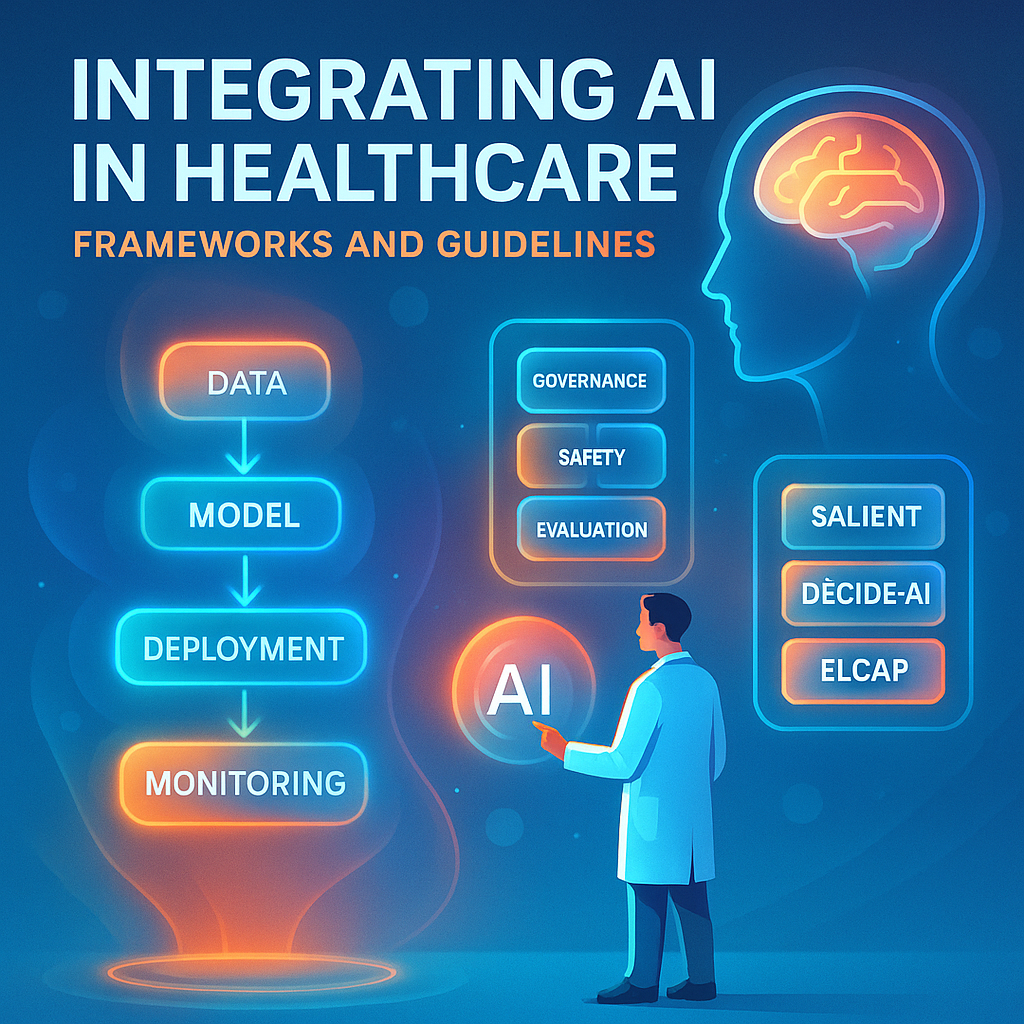
AI is not ruling healthcare; it’s reshaping the foundations we build on. And in this rush, the organisations that succeed aren’t the ones using the most sophisticated models, but the ones using the most disciplined frameworks.

That’s why I consistently return to a core set of AI frameworks. They anchor the excitement, provide guardrails for safety and governance, and force clarity on what we are actually trying to achieve. In my own work—whether integrating SmartLife products with NHS systems through IM1, shaping data-driven decision tools, or preparing analytics platforms for AI-powered features—these frameworks have proven invaluable.

Healthcare loves acronyms almost as much as it needs transformation. Every week, someone asks me the same question: “Where do we even start with AI in our organisation?”

It’s the right question—but often the wrong mindset. Many leaders assume AI adoption is a single decision, when in reality it’s a layered change-management journey involving clinical safety, governance, workflow redesign, regulatory alignment, analytics infrastructure, and—most underestimated of all—human behaviour.

Working across primary care data platforms, NHS integrations (IM1, PFS, Bulk Extract), analytics products, and clinical pathways, I’ve learned that choosing the right frameworks is less about picking the trendiest one and more about clarifying what problem you’re actually solving. Are you validating an early prototype? Deploying an AI decision-support tool? Creating an enterprise AI strategy? Evaluating risk? Measuring real-world impact?

Different problems require different lenses.

Below is a curated, experience-tested set of frameworks I use when guiding organisations through AI adoption—from ideation to implementation to evaluation. I’ve added commentary on how each aligns with real operational constraints we face in the NHS and primary care.

This article outlines 12 AI frameworks I rely on and why they matter. Whether you’re evaluating your first model or planning a system-wide adoption strategy, these will help you cut through the hype and focus on what works.

1. ELCAP: ESMO Guidance for Large Language Models in Clinical Practice

A pragmatic guide for clinically safe use of LLMs.

Where it helps in practice:

Use this as your clinical acceptance criteria when piloting GPT-style tools for triage, documentation, coding support, or patient communication. It’s strong at articulating risks clinicians care about (hallucination, ambiguity, trust).

2. QUEST: Human Evaluation Framework for LLMs in Healthcare

Focuses on human–AI interaction quality.

Why it matters operationally:

Most AI failures aren’t algorithmic—they’re behavioural. QUEST is excellent for assessing whether staff can meaningfully use your tool and whether it improves decision clarity rather than adding cognitive load.

3. FUTURE-AI: Best Practices for Trustworthy Medical AI

A gold-standard reference for governance, fairness, transparency, and safety.

My take as a product lead:

This is where your SCAL, DPIA, clinical safety case, and hazard logs belong. It gives your governance team a shared vocabulary and stops “trust” from becoming a buzzword.

4. TEHAI: Evaluation Framework for Implementing AI in Healthcare Settings

A structured evaluation framework for assessing readiness and impact.

In the real world:

TEHAI helps you pressure-test whether your AI system can survive the organisational ecosystem—data flows, workflow integration, interoperability, clinical oversight, commissioning requirements, etc.

Good to use before an ICB deployment or scaling beyond a pilot practice.

5. DECIDE-AI: Guideline for Early Clinical Evaluation of AI Decision Support Systems

Designed for early-stage testing and feasibility assessments.

When I use it:

During prototype and pilot phases—especially when validating AI-driven recommendations, personalised care plans, risk scores, or decision trees before exposing clinicians to them.

6. SALIENT: Framework for End-to-End Clinical AI Implementation

One of the few frameworks that covers reality end-to-end.

Why it’s underrated:

It doesn’t just say “implement AI”—it shows the sequence:

data → model → workflow → evaluation → monitoring → governance.

It’s closest to how I run AI integration projects in practice.

7. AI Evidence Pathway for Trustworthy AI in Health

A more policy-oriented framework championed for national-scale deployments.

Where it fits:

Essential for organisations engaging with NHS England, regulators, ICBs, or multi-site implementations. Strong alignment with UK assurance processes.

8. FURM: Evaluating Fair, Useful, and Reliable AI Models in Health Systems

A deceptively simple but powerful framing.

Why leaders should care:

Most organisations over-index on accuracy, under-index on fairness, and ignore usefulness entirely. FURM centres actual clinical and operational utility.

9. IMPACTS Framework: Evaluating Long-Term Real-World AI Effects

Focuses on post-deployment—where most frameworks end prematurely.

Critical insight:

The goal isn’t to launch AI. The goal is to sustain value and avoid regressions. IMPACTS helps measure whether your deployed solution meaningfully changes outcomes, costs, or experience.

10. Process Framework for Successful AI Adoption in Healthcare

A meta-framework showing the organisational capabilities required:

stakeholder alignment, workflow fit, policy readiness, training, trust-building.

My take:

This is the antidote to “AI as an IT project.” AI success is organisational, not technical.

11. The “3L Model”: Latency, Liability, and Literacy

A brutally practical test before deploying any AI tool in a real clinical environment.

Ask:

  1. Latency – Is the AI fast enough to fit the workflow? Slow = unusable.
  2. Liability – Who is accountable for the decision? If the answer is unclear, the deployment is premature.
  3. Literacy – Do staff understand what the AI can’t do? Most clinicians don’t need to know how AI works—but they must know where its limits lie.

This model has saved several projects I’ve worked on from misaligned expectations.

12. The “Integration Trifecta”: Data → Workflow → Governance

Every AI implementation that fails usually breaks on one of these:

  1. Data: Is the data clean, real-time, coded, and interoperable?
  2. Workflow: Does it reduce clicks, not add them?
  3. Governance: Is safety, oversight, and auditability built in from day one?

In our IM1 and SCAL work, this trifecta is the backbone:

data extraction and mapping, API integration, safety case review, hazard logging, and clinical sign-off all flow through these gates.

What I’ve Learned Building AI in Healthcare

Leading AI initiatives in primary care analytics and NHS interoperability has taught me a few uncomfortable truths:

  • Most organisations want AI but haven’t articulated the problem it should solve.
  • Governance teams want safety; clinicians want usefulness; leadership wants ROI. AI rarely satisfies all three at once without deliberate design.
  • You cannot “bolt on” AI to a broken workflow—AI amplifies workflow issues.
  • The gap between pilot success and system-wide adoption is bigger than most leaders predict.
  • Evaluation frameworks don’t replace judgement—they sharpen it.

Frameworks don’t give you answers; they give you structure. The thinking still has to be yours.

Which Framework Should You Start With?

Here’s a simple test:

  • Building a prototype? → DECIDE-AI + QUEST
  • Preparing for pilot? → SALIENT + TEHAI
  • Aiming for clinical deployment? → ELCAP + FUTURE-AI
  • Scaling across an ICB or enterprise? → AI Evidence Pathway + IMPACTS
  • Ensuring fairness and trust? → FURM
  • Want an operational sanity check? → Integration Trifecta + 3L Model

If you wanna share your experiences, you can find me online in all your favorite places  LinkedIn and Facebook. Shoot me a DM, a tweet, a comment, or whatever works best for you. I’ll be the one trying to figure out how to read books and get better at playing ping pong at the same time.

 
Leave a comment

Posted by on December 2, 2025 in Experiences of Life.


Tags: , , , ,

Why Healthcare IT Graveyard Is Getting Crowded


Each minute of our life is a lesson but most of us fail to read it. I thought I would just add my daily lessons and the lessons that I learned by seeing the people around here. So it may be useful for you and as memories for me.

I’ve spent more than a decade building healthcare products across Europe, Asia, and the U.S. I’ve led Quality, Product, and Delivery at scale. I’ve watched companies grow explosively, and I’ve watched companies vanish overnight literally.

And after 15 years working in healthcare, the pattern is painfully clear:

Healthcare tech doesn’t fail because of weak engineering. It fails because founders fundamentally misunderstand healthcare.

Here’s the uncomfortable truth — backed by recent, spectacular collapses.

The Graveyard Is Getting Crowded

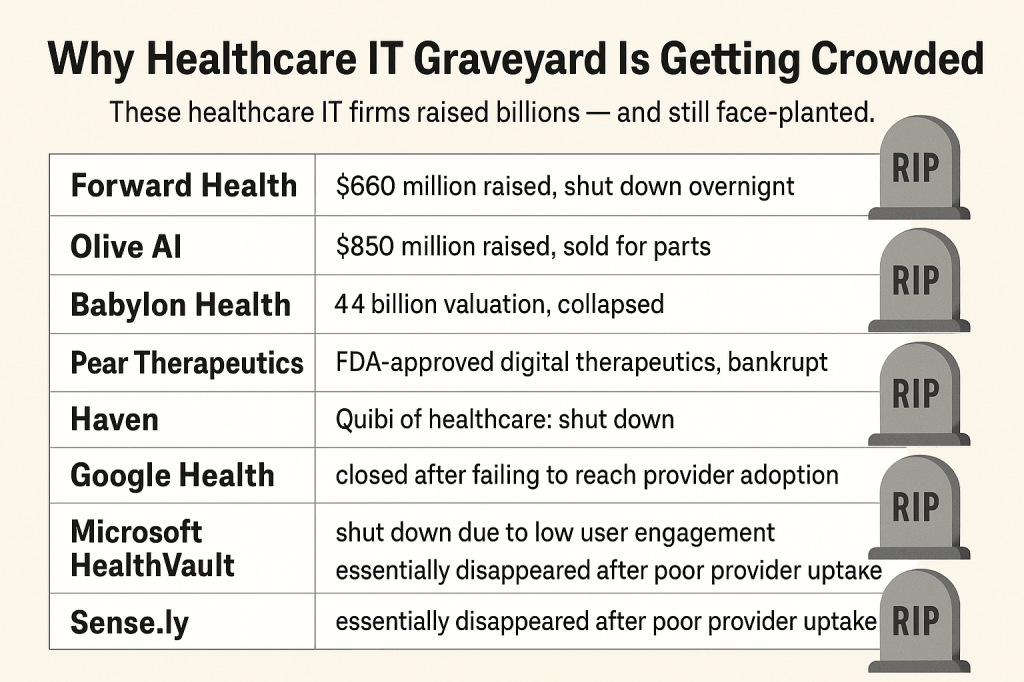
These aren’t small startups. These were the darlings of global healthcare tech:

  • Forward Health – $660M raised, shut down with zero patient transition
  • Olive AI – $850M raised, sold for parts after failing to justify ROI
  • Babylon Health – $4B valuation, blew up across multiple continents
  • Pear Therapeutics – FDA-cleared digital therapeutics, bankrupt
  • Quibi of Healthcare: Haven (Amazon–JPM–Berkshire) – shut down despite unlimited resources
  • Google Health (v1) – closed after failing to reach provider adoption
  • Microsoft HealthVault – shut down due to low user engagement and system complexity
  • Sense.ly (AI nurse avatar) – essentially disappeared after poor provider uptake
  • 23andMe Therapeutics spinout – quietly scaled back after no viable clinical revenue stream
  • Walgreens / Theranos fallout – major proof that hype beats due diligence in this sector
  • Proteus Digital Health (smart pill) – raised $500M, then bankrupt
  • Practice Fusion – sold for pennies after criminal investigations and failed EHR monetization
  • ZocDoc expansion failure – pivoted multiple times after failing to win provider-side economics
  • Oscar Health (several failed geographic launches) – struggled due to regulatory economics
  • IBM Watson Health – $3B+ investment, divested for $1B after clinical failures

This list is long. And growing.

The Core Misunderstanding: Healthcare Is Not a Tech Problem

Engineering-driven founders consistently misdiagnose the domain.

They believe healthcare = complex workflows + messy data + outdated UI.

Solve that and… success.

But healthcare is not a systems problem.

It is a trust problem wrapped in regulation, economics, and risk.

  • Lives are at stake — not convenience.
  • Medical decisions require validated evidence — not beta features.
  • Clinicians rely on reliability and accountability — not iteration velocity.
  • Patients don’t adopt new care models without months or years of trust-building.

Every failed company ignored these constraints.

The Integration Trap: The Silent Killer

This is where most companies die.

Healthcare runs on a brittle spine of EMRs, APIs, and legacy systems.

If you don’t integrate, you don’t exist.

  • Forward’s CarePods were genuinely innovative. But without seamless EMR connections, they became operationally useless.
  • Olive AI automated tasks internally… but could not standardize ROI across EMRs.
  • IBM Watson Health promised AI-driven oncology decisions. But the recommendations were inconsistent with evidence-based guidelines.

The rule:

If you don’t reduce workload inside the existing workflow, clinicians will ignore you.

No integration = no adoption.

No adoption = no revenue.

No revenue = shutdown.

Why Consumer Tech Logic Fails in Healthcare

Tech founders try to import playbooks from SaaS, marketplaces, and fintech:

  • “Move fast and break things”
  • “Launch MVP, iterate later”
  • “Acquire users, figure out monetization later”
  • “Data is the new oil”
  • “AI will replace inefficiencies”

These logics collapse immediately in healthcare:

  1. Healthcare data is not clean; 80% is unstructured.
  2. Interoperability is not an optional feature — it is the foundation.
  3. Clinicians require evidence, not velocity.
  4. Patients are not early adopters; they are risk-averse by necessity.

The market punishes anyone who treats healthcare like another consumer vertical.

The Reimbursement Illusion: Where Startups Bleed Out

This is the part Silicon Valley consistently ignores.

In healthcare, value is NOT determined by the end user.

Value is determined by:

  • payors
  • reimbursement codes
  • medical necessity rules
  • regulatory status
  • clinical outcomes data

A product can delight users and still die if:

  • there’s no CPT code
  • insurers won’t reimburse
  • the product doesn’t reduce provider workload
  • there’s no proven cost savings

Olive AI is the textbook example.

Automation sounded brilliant — but if hospitals can’t bill for it, the business collapses.

Pear Therapeutics had FDA clearance, efficacy data, and clinical logic.

Still died because payors refused to reimburse at scale.

Healthcare economics — not innovation — determine survival.

What Actually Works (and Why It Looks “Unsexy”)

The successful products in healthcare are almost never glamorous:

  • Automated population stratification
  • Scheduling optimization
  • Revenue cycle improvements
  • Medication adherence
  • Secure messaging
  • Chronic disease workflows
  • Interoperability middleware
  • Claims cleaning and fraud detection

Unsexy wins because it integrates, it reduces workload, it fits reimbursement, it avoids clinical risk, and it solves one painful problem extremely well.

The companies that succeed do the following:

  • Integrate seamlessly with EMRs
  • Prove ROI early
  • Reduce clicks, not add them
  • Earn clinical champions, not marketing awards
  • Build for the system as it is, not the system they wish existed
  • Grow slowly but sustainably — not explosively and unsafely

Healthcare rewards evolution, not revolution.

Forward Health’s Shutdown Is the Perfect Case Study

Forward turned off the lights overnight:

  • No transition pathway
  • Canceled appointments
  • Patients left stranded
  • Systems turned off immediately

This is what happens when a company:

  • optimizes for investor excitement instead of clinical safety
  • designs for TechCrunch instead of clinicians
  • prioritizes disruption over integration
  • treats healthcare as a retail subscription business instead of a regulated service

Patients pay the real cost of these failures.

The Real Pattern Behind Every Healthcare Tech Collapse

Let’s stop pretending these are isolated incidents.

The failures follow the same template:

  1. Overpromise with polished demos
  2. Underestimate the complexity of clinical workflows
  3. Blow capital on growth before solving integration
  4. Fail to secure reimbursement pathways
  5. Struggle to prove clinical and financial ROI
  6. Lose trust from clinicians
  7. Run out of money
  8. Collapse suddenly
  9. Patients and providers are left scrambling

Money and engineering talent are not substitutes for:

  • clinical insight
  • regulatory design
  • healthcare economics
  • trust-building
  • real-world workflow alignment

The Hard Truth

Healthcare rewards reliability over innovation.

Simple solutions outperform brilliant ones.

Integration beats disruption every time.

I’ve watched billion-dollar firms fail and small scrappy teams succeed.

The winners understood healthcare is a trust-based, evidence-driven system.

The losers thought they could brute force the market with capital and code.

They were wrong.

Your Turn

What healthcare product promised everything and delivered nothing?

If you wanna share your experiences, you can find me online in all your favorite places  LinkedIn and Facebook. Shoot me a DM, a tweet, a comment, or whatever works best for you. I’ll be the one trying to figure out how to read books and get better at playing ping pong at the same time.


Tags: , , , , , , , , ,

The Gamification of Healthcare


Each minute of our life is a lesson but most of us fail to read it. I thought I would just add my daily lessons & the lessons that I learned by seeing the people around here. So it may be useful for you and as memories for me.

In today’s fast-paced healthcare landscape, the integration of technology has become more crucial than ever. One innovative approach that is gaining traction is the gamification of healthcare apps and tools for clinical staff.

Gamification in healthcare continues to gain momentum! You may perceive it merely as a marketing tactic employed by app developers to attract users or as an effort to cater to the preferences of modern, fun-loving patients. However, the reality is that gamification offers much more than mere entertainment and holds value for individuals of all ages.

While gamification may not offer a cure for medical conditions, it serves as a powerful tool to motivate individuals to adopt healthy lifestyle habits and overcome challenging health-related tasks, ultimately leading to enhanced patient outcomes. Moreover, the potential benefits of gamification extend beyond patient satisfaction; they also positively impact healthcare providers and practitioners.

Creator: cnythzl

Discovering the remarkable potential and benefits of gamification for health app users—patients, providers, and practitioners alike—may surprise you. Let’s delve into the myriad benefits:

Enhanced Engagement: By infusing elements of gameplay into everyday tasks, healthcare apps become more engaging for clinicians. Whether it’s completing training modules or documenting patient data, gamification captivates attention and encourages active participation.

Improved Learning Outcomes: Traditional training methods can sometimes feel tedious and uninspiring. Gamified healthcare apps offer a dynamic learning environment where clinicians can acquire new skills and knowledge through interactive challenges and simulations. This immersive experience not only increases retention but also promotes continuous learning.

Boosted Motivation and Productivity: Gamification introduces elements such as point systems, badges, and leaderboards to incentivize clinicians. As they strive to earn rewards and achieve milestones, motivation levels soar, driving higher productivity and performance across the board.

Fostered Collaboration and Teamwork: Many gamified healthcare apps incorporate social features that facilitate collaboration among clinical teams. Whether it’s solving puzzles together or sharing achievements, these platforms promote camaraderie and strengthen teamwork, leading to better patient care outcomes.

Data-Driven Insights: Gamification allows for the collection of valuable data regarding user behavior and performance. Analyzing these metrics provides insights into areas of strengths and weaknesses, enabling healthcare organizations to tailor training programs and interventions effectively.

Reduced Burnout and Stress: The immersive and enjoyable nature of gamified healthcare apps can serve as a welcome break from the demands of clinical work. By offering a moment of respite and fun, these tools contribute to reducing burnout and alleviating stress among healthcare professionals.

Empowered Patient Education: Beyond the clinical setting, gamification can also play a crucial role in patient education. Interactive health apps that incorporate gamified elements make learning about medical conditions and treatment protocols more accessible and engaging for patients, ultimately empowering them to take control of their health.

In conclusion, the gamification of healthcare apps and tools holds tremendous potential to transform the way clinical staff engage with technology and deliver care. By harnessing the power of gamification, we can create a more dynamic, rewarding, and effective healthcare ecosystem for clinicians and patients alike.

Let’s embrace this innovative approach and unlock a brighter future for healthcare together!

If you wanna share your experiences, you can find me online in all your favorite places  LinkedIn and Facebook. Shoot me a DM, a tweet, a comment, or whatever works best for you. I’ll be the one trying to figure out how to read books and get better at playing ping pong at the same time.

References:

 
Leave a comment

Posted by on February 15, 2024 in Experiences of Life.


Tags: , , , , , , , , ,

Rebuilding the Broken Healthcare System: Empowering Patients with Data Ownership and Control


Each minute of our life is a lesson but most of us fail to read it. I thought I would just add my daily lessons & the lessons that I learned by seeing the people around here. So it may be useful for you and as memories for me.

In our current healthcare landscape, the need for a comprehensive overhaul is undeniable. From rising costs and administrative inefficiencies to data privacy concerns, the system is in dire need of transformation. Fortunately, the key to rebuilding a more robust and patient-centric healthcare system lies in placing the power back into the hands of the patients themselves.

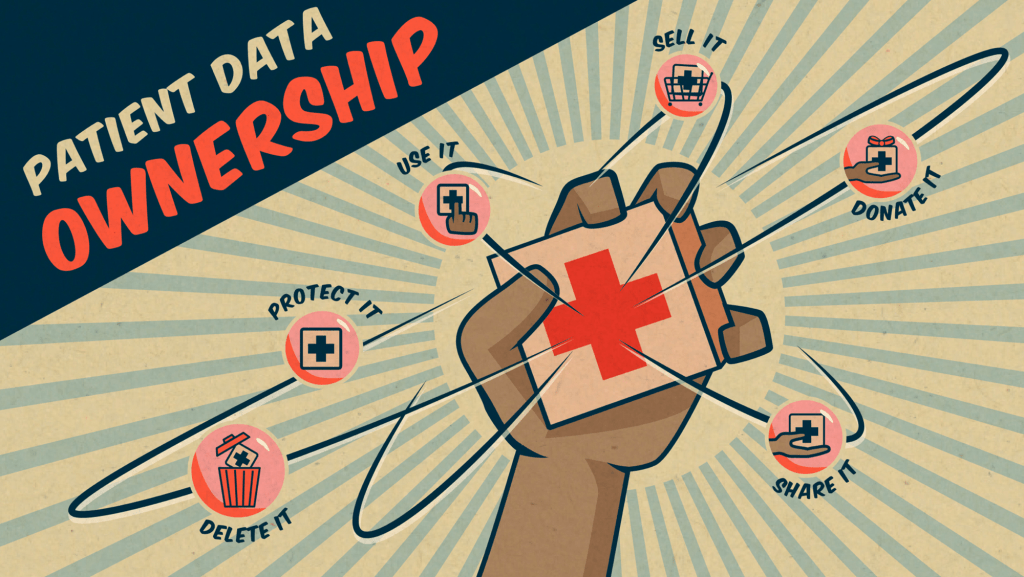
One of the fundamental pillars of this transformation is the idea that patients should have full ownership of their health data. By granting patients the autonomy to access, manage, and share their own data, we can foster a sense of empowerment and engagement that is crucial for their overall well-being. When patients have control over their health data, they become active participants in their care journey, leading to better health outcomes and increased satisfaction with the healthcare process.

Moreover, it is imperative to ensure that patients have complete control over who can access their data and for what purpose. This approach not only safeguards patient privacy but also fosters a sense of trust between patients and healthcare providers. By allowing patients to dictate which providers, applications, and researchers can utilize their data, we can establish a more transparent and collaborative healthcare ecosystem that prioritizes patient preferences and values their consent.

Empowering patients to own their healthcare data is a critical step in enhancing transparency, fostering patient engagement, and promoting personalized care. Here are several key steps that can be implemented to ensure patients have ownership of their data:

  1. Data Access Portals: Implement user-friendly online portals that allow patients to access their medical records, test results, and treatment history easily.
  2. Data Download and Sharing Options: Provide patients with the ability to download their health data in a standardized, accessible format, enabling them to share it with other healthcare providers as needed.
  3. Consent Management Tools: Integrate consent management tools that enable patients to control who can access their data and for what specific purposes, ensuring transparency and privacy protection.
  4. Patient-Generated Data Integration: Enable patients to contribute data from personal health devices, such as wearable fitness trackers and smartwatches, to create a more comprehensive view of their health status.
  5. Education and Training Programs: Offer educational resources and training sessions to help patients understand the importance of owning their data, how to access it, and how to utilize it for better self-care and decision-making.
  6. Data Security Measures: Implement robust security protocols and encryption techniques to safeguard patient data from unauthorized access, ensuring compliance with privacy regulations such as HIPAA (Health Insurance Portability and Accountability Act) and GDPR (General Data Protection Regulation).
  7. Transparent Data Policies: Establish clear and transparent data policies that outline patients’ rights, data usage guidelines, and procedures for data access, sharing, and revocation of consent.
  8. Feedback Mechanisms: Create feedback channels where patients can provide input on data management processes, express concerns, and suggest improvements to enhance the overall patient experience and data ownership journey.
  9. Collaborative Decision-Making Tools: Develop platforms that facilitate collaborative decision-making between patients and healthcare providers, allowing patients to actively participate in treatment planning and goal-setting based on their personal health data.
  10. Long-Term Data Storage Options: Provide patients with the option to securely store their data for the long term, ensuring accessibility for future reference and continuity of care across different healthcare settings.

By integrating these steps into healthcare systems and practices, patients can take a more proactive role in managing their health, fostering a culture of patient empowerment, and ultimately contributing to the improvement of healthcare outcomes.

In this reimagined healthcare paradigm, the role of data usage and its impact on patient care cannot be overstated. By compensating patients based on how their data is used, we can create a fair and equitable system that acknowledges the value of their contributions. This approach not only incentivizes patients to actively participate in data sharing but also promotes a culture of mutual respect and reciprocity between patients, clinicians, and researchers.

For clinicians, the availability of comprehensive patient data is invaluable in making well-informed decisions and providing high-quality care. With access to a holistic view of a patient’s health history, clinicians can tailor their treatment plans, offer personalized interventions, and proactively address potential health concerns. The integration of patient data into clinical practice not only enhances the efficiency of healthcare delivery but also strengthens the patient-provider relationship, fostering a collaborative and patient-centric approach to care.

The journey towards rebuilding a broken healthcare system is a collective effort that requires the collaboration of healthcare providers, policymakers, and technology innovators. By placing patients at the center of this transformation and empowering them with data ownership and control, we can pave the way for a more inclusive, efficient, and patient-driven healthcare system that prioritizes the well-being and autonomy of every individual.

Through a concerted commitment to patient empowerment, data privacy, and collaborative care, we can lay the foundation for a healthcare ecosystem that not only delivers high-quality care but also fosters a culture of trust, transparency, and patient-centricity. It is time to rebuild our healthcare system, one that truly values and prioritizes the needs and rights of every patient.

Title: Rebuilding the Broken Healthcare System: Empowering Patients with Data Ownership and Control

In our current healthcare landscape, the need for a comprehensive overhaul is undeniable. From rising costs and administrative inefficiencies to data privacy concerns, the system is in dire need of transformation. Fortunately, the key to rebuilding a more robust and patient-centric healthcare system lies in placing the power back into the hands of the patients themselves.

One of the fundamental pillars of this transformation is the idea that patients should have full ownership of their health data. By granting patients the autonomy to access, manage, and share their own data, we can foster a sense of empowerment and engagement that is crucial for their overall well-being. When patients have control over their health data, they become active participants in their care journey, leading to better health outcomes and increased satisfaction with the healthcare process.

Moreover, it is imperative to ensure that patients have complete control over who can access their data and for what purpose. This approach not only safeguards patient privacy but also fosters a sense of trust between patients and healthcare providers. By allowing patients to dictate which providers, applications, and researchers can utilize their data, we can establish a more transparent and collaborative healthcare ecosystem that prioritizes patient preferences and values their consent.

In this reimagined healthcare paradigm, the role of data usage and its impact on patient care cannot be overstated. By compensating patients based on how their data is used, we can create a fair and equitable system that acknowledges the value of their contributions. This approach not only incentivizes patients to actively participate in data sharing but also promotes a culture of mutual respect and reciprocity between patients, clinicians, and researchers.

For clinicians, the availability of comprehensive patient data is invaluable in making well-informed decisions and providing high-quality care. With access to a holistic view of a patient’s health history, clinicians can tailor their treatment plans, offer personalized interventions, and proactively address potential health concerns. The integration of patient data into clinical practice not only enhances the efficiency of healthcare delivery but also strengthens the patient-provider relationship, fostering a collaborative and patient-centric approach to care.

The journey towards rebuilding a broken healthcare system is a collective effort that requires the collaboration of healthcare providers, policymakers, and technology innovators. By placing patients at the center of this transformation and empowering them with data ownership and control, we can pave the way for a more inclusive, efficient, and patient-driven healthcare system that prioritizes the well-being and autonomy of every individual.

Through a concerted commitment to patient empowerment, data privacy, and collaborative care, we can lay the foundation for a healthcare ecosystem that not only delivers high-quality care but also fosters a culture of trust, transparency, and patient-centricity. It is time to rebuild our healthcare system, one that truly values and prioritizes the needs and rights of every patient.

Join me in revolutionizing the future of healthcare. Together, we can create a system that prioritizes transparency, efficiency, and patient well-being.

If you wanna share your experiences, you can find me online in all your favorite places  LinkedIn and Facebook. Shoot me a DM, a tweet, a comment, or whatever works best for you. I’ll be the one trying to figure out how to read books and get better at playing ping pong at the same time.

 
Leave a comment

Posted by on April 8, 2023 in Experiences of Life.


Tags: , , , ,

All you need to know about IM1 Integration


Each minute of our life is a lesson but most of us fail to read it. I thought I would just add my daily lessons & the lessons that I learned by seeing the people around here. So it may be useful for you and as memories for me.

The COVID-19 pandemic accelerated the convergence of several trends in the health care industry. In UK leading health systems view digital transformation as a way to become more consumer-friendly while simultaneously changing their operations, culture, and use of technology.

Health systems consider digital capabilities a path to fundamentally transform their relationship with consumers. Digital technologies have the potential to transform people’s health care and their experiences in consuming various PFS services – the biggest benefits being streamlining and efficiency.

The healthcare industry is both large and very tightly regulated to protect healthcare data. The result is that getting healthcare tools, applications approved for NHS systems integration means jumping through many hoops. In 2021 getting any new Healthcare app or service approved by the NHS is complicated. Firstly, because patient data must be protected, and secondly because there are so many people and services involved in the NHS that it can’t move as quickly it wants. The situation is further confused because responsibilities for the use of digital technology in the NHS is split between NHS England, NHS Digital, the Department of Health and Social Care, as well as others.

What the IM1 Pairing Integration is?

The IM1 Pairing Integration (IM1) is a technical tool and process that allows digital suppliers to directly talk to GP clinical systems (supplied by EMIS, Vision, TPP), both reading data from the systems and putting data into the systems. 

In simple terms it is a process that allows suppliers to integrate their system with any principal clinical system through an interface mechanism. It supports system standards and interoperability within local organisations and across local health and social care communities. You can find more information about each of the IM1 interfaces by downloading a copy of the interface mechanism fact sheet.

IM1 pairing standards can help integration with NHS Patient Facing Services. It also is a technical tool and process that allows digital suppliers to directly talk to GP clinical systems, both reading data from the systems and putting data into the systems.

NHS provides APIs to access various data resources, including:

  • Data held in GP systems
  • Data held in the Spine

The main challenge for app developers remains the minefield of standards and compliance that needs to be navigated for a new app to be successfully deployed .

Any consuming supplier can apply to ‘pair’ their service with any provider supplier system, but there are a number of prerequisites set out by NHS Digital that they must meet in order to be deemed compatible.

Following API standards support the integration of your systems with any principal clinical GP system using IM1. The API standards enable your system to access GP practice systems to perform following actions:

  • read patient information
  • extract information in bulk
  • enter data into your system

Start the IM1 Integration Journey:

After working with different Healthcare service provides on various roles as Quality Control Manager, Delivery Manager, Scrum Master and Operations Lead in last 15 years, I gained good Healthcare domain knowledge and also gained understanding and knowledge on IM1 Integration process and the steps involved in total implementation journey.

From my personal experience, the process is very robust, and for that reason can be incredibly frustrating and demotivating for many teams.. Adding in the complexity of different requirements from the separate clinical systems providers (EMIS, Tpp, Vision etc) , it can be a very demanding process. 

The process for integrating with IM1 is pretty well documented by NHS team which you can find on their official website. Any consuming supplier can apply to ‘pair’ their service with any provider supplier system, but there are a number of prerequisites set out by NHS Digital that they must meet in order to be deemed compatible.

The IM1 Integration starts with IM1 prerequisites form. Next step is mapping out what you’re trying to achieve, which is then transposed over to a SCAL (Supplier Conformance Assessment List). To establish clinical safety prerequisites are in place and confirmation that you can commit to information governance prerequisites in order to progress the onboarding process. 

Once your product has been deemed compatible, you’ll be asked to complete a Model Interface Licence with each of the provider suppliers, giving you access to a test environment using the unique provider supplier guidance.

The SCAL is used as the basis to communicate with NHS Digital, and outlines your product, with details of clinical and information governance (IG) use cases. NHS Digital then assesses whether your product is compatible with the IM1 API, and if so you are given access to an unsupported test environment to begin development. 

After development has completed in the unsupported test environment, you are given access to the supported environment, where you are able to agree the assurance approach with the clinical system providers before proceeding to the assurance stage.

Each clinical system provider has their own requirements for assurance, with differing levels of test cases and auditing requirements. Upon agreeing a date with each provider, we booked in for witness testing and presented the required test cases and information to each separately. 

From that point, the provider signs off assurance from their perspective, then NHS Digital does assurance on their end which involves differing levels of sign off in relation to information governance and clinical safety.

Once NHS Digital has signed off the assurance, a recommendation to connect notice is sent across to the clinical system provider and arrangements are made to move across to the live environment.

Integration pairings

In order to join the list of assured suppliers, your product will need to ‘pair’ with one of the following specific APIs for each GP practice system supplier:

  • Patient API: this API allows patients or an authorised representative to book, request, view, amend and cancel appointments or repeat prescriptions, and allows patients to communicate with GP practices directly.
    • view available appointments
    • book an appointment
    • amend or cancel an appointment
    • view their repeat medication
    • request a repeat prescription
    • amend or cancel a prescription request
    • view their medical record
    • communicate with the GP practice
  • Transaction API: with the patient and GP practice system’s permission, this API gives medical professionals access to a whole host of real-time information, ranging from retrieving attachments from a patient’s medical records to creating a new consultation record.
    • search for a patient
    • retrieve and update patient demographics
    • retrieve a full patient medical record
    • file data to a patient record
    • retrieve a patient consultation record
    • create a new patient consultation record
    • add a document or attachment to a consultation record
    • retrieve documents from a patient Record
    • file documents into a patient record
    • retrieve an attachment from the patient’s medical record.
    • retrieve a list of all the attachments residing in the patient’s medical record
    • retrieve a list of patients whose registration details have changed
    • retrieve the list of active users from a given organisation
    • delete data from a patient’s record
    • retrieve appointment slots
    • access diary information
    • query details of free slots in the appointment book
    • extract CSV files
  • Bulk API: once GP practice consent has been obtained, this API empowers your application to gain daily, weekly or monthly extracts of bulk data feeds of patient or clinical system user data. The mechanisms for delivery of data will vary by system supplier.
  • Partner API: similar to the Transaction API, this API offers more up to date information about patients that may have changed since the last query was made e.g. age, sex or the status of an appointment. This API is only applicable with the EMIS Web GP module and to practices based within England. Note that the EMIS Community module is not available currently via IM1. 
    • a single patient demographic and medical record
    • a list of patients – for example, for finding or searching for patients
    • a list of patients with appointments booked
    • a list of patients to update, and age or sex register output
    • information about the organisation or users
    • a list of patient registration details for patients that have changed since the last query
    • appointment and appointment configuration information
    • retrieval of documents from a patient record
    • filing of documents into a patient record
    • retrieval of an attachment from a patient’s medical record
    • retrieval of a list of all the attachments in a patient’s medical record
    • booking and cancellation of appointments
    • setting an appointment’s status
    • viewing a patient’s arrived and sent-in status

All the above information is gathered from various reliable Healthcare sites and from the my experience as a Agile Delivery Manager by working for various clients.

There are many challenges to building a software solution for the healthcare sector. Any application requiring NHS integration must meet strict NHS digital technical healthcare standards to gain compliance and approval. Any error in assuring the product during the onboarding process can result in costly delays.

Before beginning the integration process, you will need to formulate a realistic project plan and understand if this is something your customers are happy to pay for. This process can take several months to a year or more, so the investment is high and the thresholds for sign-off are tough, understandably so. Make sure your project team is heavy in good communicators, technical knowledge (ideally with health expertise), and those who are adaptable and can pivot if needed.

I hope you have found the information helpful for starting your journey with the IM1 framework. Good luck 🍀

Some Important links and references:

https://digital.nhs.uk/services/api-platform

https://developer.nhs.uk/apis/gpconnect-0-5-3/index.html

https://6b.digital/insights/what-is-nhs-im1-interface-mechanism

https://gpitbjss.atlassian.net/wiki/spaces/DCSDCS/overview?homepageId=11995152703

https://digital.nhs.uk/developer/api-catalogue/interface-mechanism-1-standards

https://digital.nhs.uk/services/gp-it-futures-systems/im1-pairing-integration#process

https://github.com/NHSDigital/nhs-app-sample-web-integration

https://github.com/NHSDigital/nhs-app-api

If you wanna share your experiences, you can find me online in all your favorite places  LinkedIn and Facebook. Shoot me a DM, a tweet, a comment, or whatever works best for you. I’ll be the one trying to figure out how to read books and get better at playing ping pong at the same time.
 
Leave a comment

Posted by on December 16, 2021 in Technical, Work Place


Tags: , , , , , , , ,

Patient Management System


Each minute of our life is a lesson but most of us fail to read it. I thought I would just add my daily lessons & the lessons that I learned by seeing the people around here. So it may be useful for you and as memories for me.

The advancements in healthcare industry are not just confined to the quality medical care solutions but also to change the delivery system and patient experience as a whole. All the industries have understood the innate potential of automation and the results are quite optimistic. It is a now time for the healthcare industry transformation, in the light of emerging automation solutions in the hospital management system.

In the current age, Time and health are two precious commodities. Patient management can help improve both. It helps in Improving the quality of patient care, making optimal use of resources, ensuring compliance with all statutory requirements and at the same time staying ahead of the competition requires stable IT support.

Patient management is a broad term, with two categories of definitions. One definition refers to a software tool that streamlines processes within a medical practice or hospital, and the other refers to an entire system of care involving both patient and practice. 

Paying attention to patient management can have many benefits for medical practices and hospitals. Speeding up communications and administrative tasks reduces administrative staffing time and allows staff to focus on direct patient care. The amount of time spent on data entry, record keeping, and appointment reminder phone calls is also reduced.

A patient management system often goes beyond just being an electronic health record or electronic medical record (EMR). Government incentives helped expedite the move towards electronic health records, and many practices realized that other software and systems could be beneficial. Patient management software can integrate appointment history, patient information, diagnoses, prescriptions, billing records, and more. It can also help practices and hospitals reduce costs by automating some tasks like appointment scheduling, sending reminders, and billing. 

Functionality and needs differ depending whether or not the medical practice is small and independent or part of a larger medical group. PMS systems work entirely differently within a hospital setting. The software can link practices and medical offices so things like patient records are easy to access on a variety of devices in different settings.

A patient management software system can provide any of the following functions. Not all of the patient management software features listed below are included in any single software application. However, each feature is part of some patient management systems currently available. This comprehensive list can help you understand your practice’s unique requirements and get a head start on the software selection process.

  1. Welcome patients to a practice or hospital and allow people to sign in
  2. Screen identification and print badges for visitors
  3. Complete forms before appointments to decrease patient time spent in the waiting room and administrative time spent inputting data
  4. Keep medical records and allow easy accessibility from a variety of locations including from a mobile device
  5. Schedule appointments and allow patients to see what is available and pick the best time for them
  6. Send confirmations of appointments and place them on an electronic calendar
  7. Send reminders about appointments, hopefully reducing the number of no-shows
  8. Send follow-up health information, advice, and reminders of what physicians said to do to increase patient participation in their own health care
  9. Notify physicians when patients arrive to decrease wait times
  10. Keep records of patient encounters so both physicians and patients can refer to previous conversations and appointments
  11. Monitor and receive data from medical devices and provide alerts both to physicians and patients if medical attention is necessary
  12. Allow emails and conversations between patient and physician
  13. Generate bills and insurance claims
  14. Regardless of the software a medical practice or hospital chooses, it still needs to adhere to some pre defined rules and comply with GDPR

Final Thoughts

Patient management software sets new standards for excellence in patient care. It provides healthcare facilities of all sizes with greater economy, enhanced quality of service, more accuracy and more efficiency. Programs are available to suit a variety of medical practice needs. Now that you know what features to expect, you can start gathering requirements and comparing vendors in the industry. Good luck on your journey to better patient care!

References: DigitalHealthBuzz, Smartsheet, Selecthub and healthcare portals

Please feel free to share your story and any lessons you learned, you experienced, you came across in your life in the comments below. If you enjoyed this, or any other other posts, I’d be honoured  if you’d share it with your family, friends and followers!

If you wish to follow my journey outside of my writing, you can find me on Facebook (https://www.facebook.com/MunnaPrawin) Instagram(MunnaPrawin) and Twitter(@munnaprawin1).

 
1 Comment

Posted by on October 2, 2020 in Technical, Work Place


Tags: , , , , ,

 
Design a site like this with WordPress.com
Get started