RSS

Tag Archives: Leadership Lessons

Do You Maintain a Healthy Work Environment?


Each minute of our life is a lesson but most of us fail to read it. I thought I would just add my daily lessons & the lessons that I learned by seeing the people around here. So it may be useful for you and as memories for me.

As a Leader Are you cultivating a positive work environment for your team’s success?

In 21st century, Leaders have more responsibility to create environments where dignity, integrity, honesty, and compassion are keystones of the workplace. A healthy leader is one who understands the importance of their team members’ emotional well-being.

In a leadership position, it’s your responsibility to listen to what your team needs for a healthy workplace environment. Employees are, after all, the heart of the company and the best ambassadors for your brand. Taking care of the office environment will not only improve the overall mood at work, but will increase employee loyalty, work productivity, and team relationships.

Employees’ mental health is likely only to worsen with the present tumultuous economic climate and the drastically changing 21st century workplace. As employees reckon with this, employers may be faced with more employees going on medical leaves or resigning altogether. Having strong mental health support system, may be vital for businesses to grow and thrive and may enable them to attract top talent and retain productive workers.

As a Leader its your responsibility to create a Healthy work environment, where your employees can contribute towards the success of the team and organisation.The mental health and wellbeing of your employees should be a priority for any company. In order for your employees to be happy and successful within your company, it’s important for you to demonstrate how much your care and that the support is there!

Mental health at work refers to the psychological well-being of employees in their work environment. It includes factors such as job satisfaction, work-related stress, burnout, anxiety, depression, and other mental health issues that can arise from work-related pressures and demands.

Like chronic diseases, mental health disorders are treatable, and employers can use comprehensive strategies to cultivate supportive work environments.

The health and wellbeing of your employees should always be a priority in your workplace, make sure that you implement some of the strategies mentioned to keep your employees happy and healthy! Employers need to be more aware of their employee’s feelings than ever before and offer support and guidance to their employees. 

Several factors contribute to poor mental health in the workplace, which can lead to high turnover and a reduction in productivity for a business. These risk factors typically include the workplace structure, interactions at work, how managers function, and the availability of support.

  • Bullying and harassment: A healthy workplace should be void of any mistreatment and hostility.6
  • Micromanagement: 70% of employees who experienced micromanagement considered quitting their jobs.
  • Lack of resources: It is challenging to succeed at work without proper support from a company and its managers.
  • Silence regarding mental health issues: Employees may feel like they need to hide their mental illness when a company exhibits a discriminatory or toxic culture.
  • Inflexible hours and time off: A lack of flexibility can negatively impact employees’ mental wellbeing.
  • Unclear responsibilities and expectations: When expectations aren’t clear, employees are more likely to make mistakes and receive ridicule. This issue can be hard to address, especially when there is a lack of effective communication.
  • Unreasonable expectations: When employees are given tasks that do not align with their experience and training, this can set them up for failure.
  • Poor work-life balance: Employees who are unable to create separation between their profession and personal life are more likely to experience burnout and a lack of productivity.

Post Covid-19, Mental health at work is important for several reasons. Firstly, it affects the overall well-being and productivity of employees, as well as their job satisfaction and engagement. Secondly, it can impact the performance and success of the organization, as employees who are struggling with mental health issues may have difficulty concentrating, making decisions, and working effectively with others.

However, organisations looking to address mental health issues in their workplaces must first assess the culture and leadership team. Having the right culture and a supportive leadership team are key factors to drive an effective and more positive work environment. Therefore, organisations need to coach their leaders on reinforcing an empathetic and more inclusive culture to encourage employees’ mental wellness, sense of relevance and optimal productivity at work.

Employers have a responsibility to create a healthy and supportive work environment that promotes good mental health. This can be achieved through a range of strategies, including providing mental health resources and support for employees, promoting work-life balance, fostering a positive and inclusive workplace culture, and addressing workplace stressors and other factors that can contribute to poor mental health.

Employees also have a role to play in maintaining their own mental health at work. This can include seeking support when needed, setting boundaries to maintain work-life balance, and practicing self-care strategies such as mindfulness, exercise, and social connection.

To support mental health at work, employers can take a number of steps, including:

  1. Creating a positive and inclusive work culture that prioritizes mental health and well-being.
  2. Encouraging open communication and providing opportunities for employees to share their experiences and concerns. Involve employees in decision making and encourage participation
  3. Offering flexible working arrangements and encourgae Hybrid work culture
  4. Educating managers and employees about mental health and how to support those who may be struggling.
  5. Be aware of the existing environment and how it can be altered to promote mental health in the workplace
  6. Learn from leaders and employees who have taken action to create a healthier workplace
  7. Utilize tools that other companies have used to promote mental health
  8. Understand that different employees may have different needs
  9. Take advantage of resources and support for employees who are struggling
  10. Implement and enforce health and safety policies, which includes identifying distress, substance abuse disorders, and illness
  11. Provide resources to manage employees who experience mental health issues and inform them that this is available
  12. Incorporate practices that support a healthy work-life balance
  13. Recognize and reward employees for their contributions

With the right strategies, you can address your mental health issues and get back on track with your overall well-being. No matter how long you’ve been ignoring your mental health, the time to dedicate to your recovery is now.

The only way to enjoy life to the fullest and experience all its wonders is if we take care of ourselves, mentally and physically. Times have changed and more and more people are changing their outlook on mental illness. However, we have a long way to go. Supporting your company’s business goals and supporting your employees’ mental health needs are not different outcomes. As you know, culture eats strategy for lunch. By investing in healthy work culture, you are supporting your employees while also addressing the bottom line.

Conclusion

A positive workplace is more successful over time because it increases positive emotions and well-being. This, in turn, improves the relationship of team members and amplifies their abilities and their creativity. This type of workplace environment is a buffer against negative experiences such as stress, thus improving staff’s resiliency to bounce back from challenges and difficulties while bolstering their overall health. It has the added benefit of attracting employees, making them more loyal to the team and to the organization as well as bringing out their strengths. When organizations develop positive cultures, they achieve significantly higher levels of organizational effectiveness — including customer satisfaction, productivity, and employee engagement. That’s a sure recipe for success. Give it a try and be the leader who inspires others.

Don’t wait another day or another week or another month. You don’t need to be dealing with this anymore. It’s time to take back control of your thoughts and emotions, and start living a happy and fulfilling life.

If you are experiencing a mental illness that you have not yet sought treatment for, it is crucial to ask for help right away. You are not alone, and there are various mental health professionals who can help you live a happier life, even in these unprecedented times.

If you wanna share your experiences, you can find me online in all your favorite places  LinkedIn and Facebook. Shoot me a DM, a tweet, a comment, or whatever works best for you. I’ll be the one trying to figure out how to read books and get better at playing ping pong at the same time.

Sources

Mental Health In The Workplace: A Look At Leaders’ Top Priorities https://www.forbes.com/

Mental Health in the Workplace During COVID-19 How Can Employers Help? https://healthblog.uofmhealth.org/

Mental Health in the Workplace.  https://www.cdc.gov/

Ultimate guide for mental health in the workplace https://socalempowered.com/

What Makes a Healthy Work Environment: https://aboutleaders.com/


Tags: , , , , ,

Do You Push Your Team Members Too Hard?


Each minute of our life is a lesson but most of us fail to read it. I thought I would just add my daily lessons & the lessons that I learned by seeing the people around here. So it may be useful for you and as memories for me.

Many of us have experienced the frustration of working for a manager who intimidates their team members while apparently charming their superiors at the same time.  But it’s hard to know if you are that type of manager.  You might think you are doing a good job.  You get results by challenging and pushing people past their comfort zones. But what if they perceive your style as overly intimidating and as a consequence they are actually afraid of you?

Some managers believe that being direct and pushy is the only way to get results.  While this can be appropriate in some situations,  it does not build a culture of trust and commitment in the long term. 

There was a company that was struggling to meet its goals and objectives.

The management team was constantly pushing their employees to work harder and faster, but nothing seemed to be working.
One day, a wise consultant was brought in to help the company improve its management practices. The consultant observed the company’s operations for a few weeks and then called a meeting with the management team.

The consultant started by telling the management team a story:

“There was a farmer who had a field of wheat that wasn’t growing well. He tried everything he could think of, but nothing seemed to help the wheat grow. One day, he decided to try something new. Instead of pushing the wheat to grow, he decided to focus on the soil. He enriched the soil, gave it the nutrients it needed, and then let nature take its course. To his amazement, the wheat grew tall and strong.”

The consultant then turned to the management team and said, “Just like the farmer, you need to focus on the ‘soil’ of your company. Your employees are the soil that your company grows in. If you invest in them, give them the support they need, and create a positive work environment, they will grow and thrive. Your company will flourish as a result.”

The moral of the story is that good management is not just about pushing people harder, but also about investing in them and creating a positive work environment that supports growth and development.

If you wanna share your experiences, you can find me online in all your favorite places  LinkedIn and Facebook. Shoot me a DM, a tweet, a comment, or whatever works best for you. I’ll be the one trying to figure out how to read books and get better at playing ping pong at the same time.

 
Leave a comment

Posted by on January 13, 2023 in Life & It's Importance, Work Place


Tags: , ,

Misner’s Corollary to Murphy’s Law


Each minute of our life is a lesson but most of us fail to read it. I thought I would just add my daily lessons & the lessons that I learned by seeing the people around here. So it may be useful for you and as memories for me.

Nearly all of us have heard the term “unintended consequences,” but we may not be aware of how to avoid them. In February 2018, in the publication The Library of Economics and Liberty, Robert Norton wrote, “The law of unintended consequences, often cited but rarely defined, is that actions of people — and especially of government — always have effects that are unanticipated or unintended.”

When we try to make a single change within a complex system, we often end up causing unintended consequences. These can be positive or negative. If we don’t anticipate unintended consequences, we can’t expect to achieve our desired outcomes.

When the unintended consequence of a decision is favorable, there is never an issue. The favorable outcome is considered a bonus. When the unintended consequence is adverse, depending on its impact, the decision-making process is questioned, as is the leader who made the decision.

Sometimes unintended consequences are catastrophic, sometimes beneficial. Occasionally their impacts are imperceptible, at other times colossal. Large events frequently have a number of unintended consequences, but even small events can trigger them. There are numerous instances of purposeful deeds completely backfiring, causing the exact opposite of what was intended.

Many entrepreneurs and executives face unexpected negative consequences after experiencing initial success, such as anxiety over being able to maintain their “winning streak”, fearing that they are being set up to fail, and experiencing the envy others feel towards their accomplishments.

If you ask yourself “What could go wrong with this?” before you launch a new business idea, you can head off some potential problems and increase the chances of a successful launch. But you also need to ask yourself about the possible unintended consequences of success. What if you fix one problem only to create several others?

And you know, the bigger the challenge, the more important it is to check and double-check, to look at what can go wrong and look at what can’t go wrong. And think those through so that you can be a little bit more prepared for a transition that you may have in your own business

For the first time in my life, I learned about “Murphy’s Law” in graduate school. It basically says that “what can go wrong, will go wrong.” Although this law feels very pessimistic, there is value to it. It gives a framework for people to look for the flaws in their thinking. When one does that effectively, it’s easier to address potential issues before they arise.

This leads me to “Misner’s Corollary: Sometimes, what can’t go wrong, will go wrong!” Here’s what I mean by that. When I have introduced something new into my business, I have often thought about what could go wrong with this new approach or idea. If you do that in advance, you truly help to head off challenges. However, what I’ve learned over the years is that you also need to think of what “can’t go wrong.”

I know this sounds crazy and even more pessimistic however if you go about this in a thought-provoking manner — you can truly think through potential challenges before you proceed. In particular, you want to consider, what I call, the “unintended consequences of a seemingly good idea.” This tends to happen when you have a solution to a problem and almost everyone agrees that the solution will definitely help with the problem. You think about how you will roll it out and avoid those things that could go wrong with that rollout and its implementation. You then roll out the idea and all goes well. What we tend to forget, however, is the unintended consequences of that new idea. In other words, the roll-out goes great but then you create a whole new set of problems that never existed and were never considered when dealing with the original problem.

The lesson learnt here — is that when you have a good idea, think about what can go wrong with that idea. If at all possible, test your ideas in advance on a small group of actual customers. They will help point out the things you didn’t think were possible or didn’t think were problems. Then, spend time thinking about what “can’t go wrong.” This means you need to really think outside the box to consider the potential unintended consequences. Most importantly — test the idea in some limited way to identify the things you thought couldn’t go wrong. Believe me when I say, you still might discover unintended consequences. The experimental testing phase is critical to avoid Misner’s Corollary.

Most unintended consequences are just unanticipated consequences. And in the world of consequences intentions often don’t matter.  Intentions, after all, only apply to positive anticipated consequences. Only in rare circumstances would someone intend to cause negative consequences.

So when we make decisions we must ask what the consequences be? This is where having a toolbox of mental models becomes helpful.

What unintended consequences have you experienced from successful business initiatives? Share your experiences and your solutions in the comments.

Source: @BNIpodcast

Please feel free to share your story and any lessons you learned, you experienced, you came across in your life in the comments below. If you enjoyed this, or any other other posts, I’d be honoured  if you’d share it with your family, friends and followers!

If you wish to follow my journey outside of my writing, you can find me on Facebook (https://www.facebook.com/MunnaPrawin) Instagram(MunnaPrawin) and Twitter(@munnaprawin1)

 
Leave a comment

Posted by on August 25, 2021 in Technical


Tags: , , , , ,

How to Be an Inclusive Leader


Each minute of our life is a lesson but most of us fail to read it. I thought I would just add my daily lessons & the lessons that I learned by seeing the people around here. So it may be useful for you and as memories for me.

The events of the past 17+ months have made it very clear that organizations and leaders within companies are looking to foster a more inclusive work culture. An inclusive culture is one that accepts, values and views as strength the difference we all bring to the table. Achieving Inclusive culture, isn’t something that can happen overnight, it can happen — by resetting workplace dynamics and implementing inclusive practices with the support of Inclusive leadership.

Building a culture of inclusion isn’t like turning on a light switch. Companies increasingly rely on diverse, multidisciplinary teams that combine the collective capabilities of women and men, people of different cultural heritage, and younger and older workers. But simply throwing a mix of people together doesn’t guarantee high performance; it requires inclusive leadership — leadership that assures that all team members feel they are treated respectfully and fairly, are valued and sense that they belong, and are confident and inspired. 

How inclusion affects your teams

Research from BetterUp shows that 1 in 4 employees don’t feel like they belong. That’s across companies, industries, and demographics. Imagine what it is for underrepresented employees.

When people don’t feel included, the cost is deeply personal. It also hurts the team. They don’t show themselves. They might hold back opposing or counterintuitive ideas and not participate in working sessions for fear of falling further out of the group. They don’t feel comfortable that their ideas and comments will be taken with the same openness and seriousness as anyone else’s. They don’t bring their unique personality, background, and interests into conversation.

They don’t take big risks or achieve big results. They don’t get noticed. They censor themselves. The cost to the team? Employees who feel excluded are 25% less productive on future tasks, have a 50% greater risk of turnover, and are less willing to work hard for the team. 

The feeling of being included comes from all of a person’s interactions, not from policy. Our data shows that the direct manager has the biggest impact. They need to be more deliberate, especially for people who feel demographically dissimilar from others in the organization and experience 27% less psychological safety as a result. 

Only 31% of employees believe their leaders are inclusive. That is, less than a third of employees believe their leaders see, value, and respect them as a whole person. Unwanted attrition, especially among employees from underrepresented groups, is an ongoing problem. Those valuable employees leave, and with them, their potential, as well as the insight about the ways the environment, culture, and leadership aren’t working. 

Most leaders and managers don’t set out intending to exclude others. Yet, in the course of pursuing a goal and relying on sometimes outmoded beliefs about leadership, they fail to get the best out of their teams. Worse, they might not even realize it. 

As you work to become a more inclusive leader, keep these experiences in mind. Not every underrepresented person will have these experiences, of course, but they are common and worth remembering as you work on demonstrating more inclusive behaviors. If individual leaders are inclusive their teams will feel safe and trust them and then they will perform better.

What is Inclusive Leadership?

Inclusive leadership is emerging as a unique and critical capability helping organisations adapt to diverse customers, markets, ideas and talent. An inclusive leader sets the tone and models the behaviors for their team to create an environment where each person feels seen, valued, respected, and able to contribute — in short, where they feel they belong and are included. 

Inclusive leadership is about actively creating an environment in which all members of your team feel empowered to contribute and feel safe to be themselves. While the tactics vary depending on the situation, at a high level, it means demonstrating empathy for team members and customers, advocating for colleagues with less institutional power, increasing your cultural and emotional intelligence, and establishing a culture that values (rather than merely accepts) diverse perspectives.

Diversity is all around us but it is up to leaders to decide whether or not to make full use of the diversity in their organisation. Inclusion is about fostering the structure, culture and mindset in an individual and leader, that enables that person to say, I fit in here, I feel valued, and I can be my true self and do not have to hide parts of my character – and because of this I can contribute to this organisation.

Lots of articles about inclusive leadership list personality traits of inclusive leaders, but that’s not the approach I take here. I believe anyone can (and everyone should) demonstrate inclusive behavior, so I focus on actions that will help develop your inclusive leadership style.

Tips for Becoming a More Inclusive Leader

What can you do to improve your inclusive leadership style? Here are a few places to start:

Reflect

I invite you to start paying attention to your own frame of reference.  Consider how your background affects the way you show up at work. Think about the ways your education, race, gender, age, physical or mental health all come into play. How comfortable are you discussing those things at work? How comfortable are your reports doing the same? 

Build trust

Inclusive leaders trust their people. They are totally committed to ‘we’ before ‘me’. If your people have to trust you as a leader you have to trust them to bring their expertise to work. Fostering trust will enable your people to feel safe and willing to contribute their unique perspectives

Slow Down

In a world where “Move fast, break things” is printed on company walls, it can feel radical to ask someone to slow down. But a few minutes of planning and thought can go a long way. Speed and spontaneity are rarely inclusive—they rely on ingrained habits, not empathy and understanding. Build new, more inclusive habits and you’ll still be able to iterate quickly without asking your underrepresented colleagues to bear the burden. 

Relationship Building

Inclusive leadership cannot be transactional. Inclusive leaders invest time in building real relationships with their team members, peers, and other employees, getting to know what matters to them and what they need to be successful. They know that each employee is a whole person who has more to offer than just the task or output they are delivering today. 

Building relationships goes beyond tolerance or accommodation. Inclusive leaders know the importance of not just being seen, but being understood and appreciated, for their whole self. 

Ask Questions

Don’t be afraid to ask questions: How do you pronounce your name? Am I addressing you the way you’d like to be addressed? How am I doing? Is there anything more you’d like to discuss?  You can’t read your employees’ minds, but you can make the space for discussion to happen.   Tip: Consider anonymous options for collecting feedback, paired with public acknowledgment and commitment to improve—remember, your employees don’t always know if they’ll have backup and may not be willing to share right away.)

Recognition

Inclusion is proactive. Inclusive leaders make an effort to recognize people for their work and support their efforts and growth. That means recognizing specifically and personally the unique contributions of others in ways that are motivating and elevate their sense of personal accomplishment. Individualized recognition and support let employees know that the skills and experiences they’ve contributed and the risks they’ve taken are seen and valued.

Encouraging participation

Inclusion is an invitation, extended day after day. Inclusive leaders use a variety of approaches to seek input and feedback directly from people who might not speak up. and check- in on what people need to be successful. They also stay attuned to obstacles that might get in the way of participation — not just in meetings but in the way work gets done — and look for ways to minimize these obstacles. 

Focus on Culture Add, not Culture Fit 

A diverse team is smarter and does better work. So why focus on whether or not someone also likes craft beer and board games? Reframe the conversation so your hiring plans can look for what new and exciting perspective someone brings to your team. As my own manager Drew Gorton puts it, “If you want better results, surround yourself with people who are meaningfully different from you.” 

Empathy

Creating an inclusive space requires having an appreciation for where others are coming from and what they might be experiencing. Inclusive leaders are warm and encouraging in their interactions, embracing compassion in order to foster deeper connections with others. They make an effort to stay connected to the daily pulse of what is going on for employees and whether they are feeling seen, valued, and respected. When a leader prioritizes empathy and models nonjudgmental behavior, it helps everyone feel more able to share their experiences and state of mind.

Fair

Inclusive leaders treat people equally in terms of opportunity and fairly according to ability. We can only do this if we know our people. Curiosity is a trait of the inclusive leader. One way to check how to be fair is by substitution. Substitute one group for another when you are looking at questions for an interview or the language you are using. 

Social connection

Interactions with other people drive our sense of being included. Inclusive leaders encourage people to recognize each other as humans, not just co-workers or adjoining parts of a process. They create opportunities for people to engage with each other — both in and out of work — to deepen their connections and model the importance of maintaining close personal relationships with supportive people in our lives.

Alignment 

Inclusion means being able to do your best work. Inclusive leaders provide shared vision and clarity to guide others. They set their people up for success and create avenues for contributing to the larger outcome. Inclusive leaders also make space for people to find their own meaning and purpose. When employees know what the organization and team are driving toward and what matters most to the organization’s success, they can better determine how best to contribute. 

Inclusion is not just about diversity. It’s about competitive advantage. And it’s a choice.

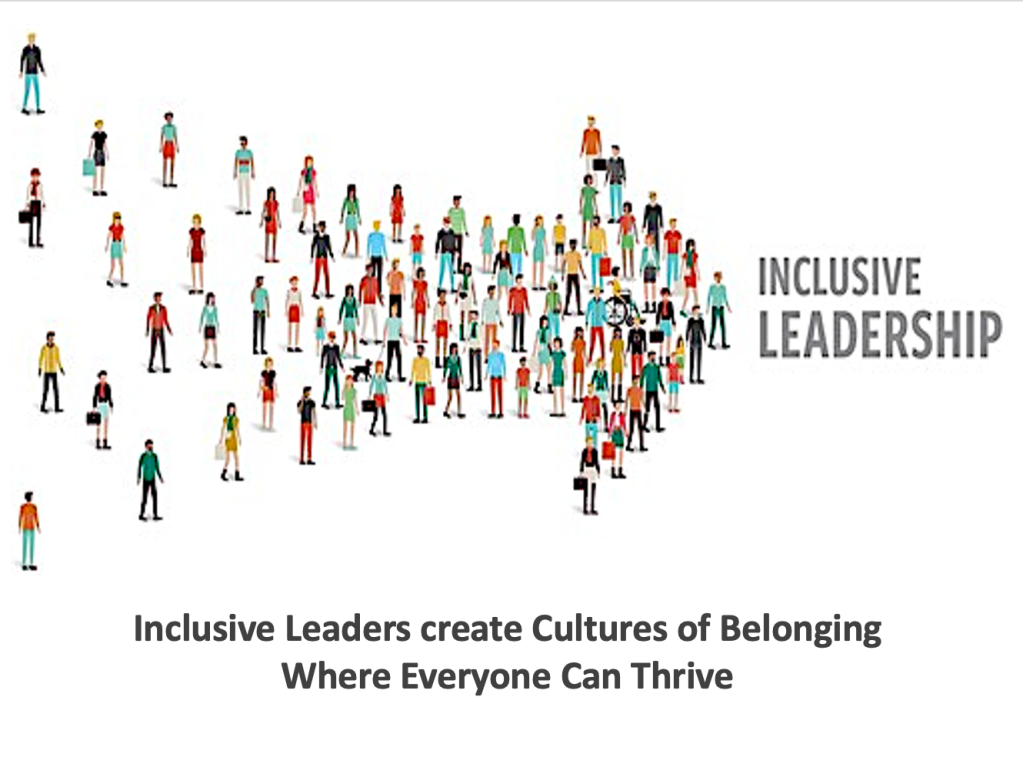
Your Role as an Inlusive Leader is Creating Cultures of Belonging Where Everyone Can Thrive.

Remember, Actions Matter 

Your actions as a leader matter. Maybe you’ve never had formal leadership training—many of us haven’t!  Whether or not you intended to end up as a manager, a team lead, or an open-source maintainer, you now hold the power to materially improve the lives of the people around you. It doesn’t matter if you don’t want this power.  As long as you are in a leadership position, it is yours and you can use it for good. 

As leaders we must remember: our teams are watching our behavior to know what is and is not acceptable. If we turn a blind eye to harassment, harassment will flourish. If we turn a blind eye to microaggressions, microaggressions will flourish.  

On the other hand, if we do a good thing, others will follow our example. If we hold ourselves and others accountable, our team will, too. If we take the time to use the right pronouns, or have an inclusive holiday celebration, our team will know it’s okay to do the same. And that’s a magical thing. 

Please feel free to share your story and any lessons you learned, you experienced, you came across in your life in the comments below. If you enjoyed this, or any other other posts, I’d be honoured  if you’d share it with your family, friends and followers!

If you wish to follow my journey outside of my writing, you can find me on Facebook (https://www.facebook.com/MunnaPrawin) Instagram(MunnaPrawin) and Twitter(@munnaprawin1)


Tags: , , , , , ,

 
Design a site like this with WordPress.com
Get started